
Q: 11
ON a stateful inspection Firewall where there is no session table, when the status detection
mechanism is enabled and the second packet (CYN+ACK) of 3-way hadshakes reaches the firewall.
Which of the following statements is true?
Options
Discussion
Probably D since with state detection on and no existing session, the firewall relies on its security policy to decide if packets pass. Had something like this in a mock, answer was always about what the policy allows. Agree?
Looks like D, since it depends on what the firewall policy allows even if the session table isn’t there. Not totally sure though.
D , policy rules take effect here since no session table is present. Not sure what Huawei expects on exam, but pretty confident D fits best in this scenario. Someone let me know if they think A is right for any reason.
D
Don’t think A is right here, since no session table gets created on that second packet (SYN+ACK) by default. D is better because it covers the case where the security policy directly permits traffic even without state. Pretty sure that’s what Huawei wants, but open to corrections.
D tbh, trap is A because people always expect session tables by default, but policy check comes first in this case.
D , Huawei's wording always trips me up but really if there's no session table, everything falls back to the permit/deny policy. Saw a similar question before. Anyone disagree?
D , the question tries to trick you into saying session table is involved but with status detection, policy still rules here.
Be respectful. No spam.
Q: 12
On an enterprise network, the directly connected interfaces of two OSPF routers are on different
network segments and have different masks. To establish an OSPF neighbor relationship between the
two interfaces, you can change their network types to which of the following?
Options
Discussion
Its A and C, since broadcast (D) and NBMA (B) still need matching masks which trips people up.
C or A both work, since P2P and P2MP types allow OSPF to form neighbors without matching subnet masks. I remember seeing a similar thing in official labs. Pretty sure that's the logic here.
A or C. Nice, clear question that checks real OSPF behavior on the mask rules.
Be respectful. No spam.
Q: 13
The traffic limiting policy feature only supports the number of connections initiated by the specified
IP or the number of connections received.
Options
Discussion
False Based on the official guide, traffic limiting is not just IP-based. Anyone else confirm from lab practice?
True . Had something like this in a mock and the explanation focused on counting connections per IP, either source or destination. I thought the feature was pretty much restricted to those criteria and didn't cover per-rule or user-based limits. If that's changed, let me know, but pretty sure it's IP connections only.
Be respectful. No spam.
Q: 14
Which of the following statements is false about the default processing of the next hop address when
a BGP device advertises a route?
Options
Discussion
Option B is the false one here. By default, when you send a route from an EBGP peer to an IBGP peer, BGP keeps the original next hop unchanged-doesn't swap it to the local interface unless you use next-hop-self. Pretty sure about this but open to corrections.
B/C? If you look at a strict default config, B is technically false because when a BGP router advertises a route learned from EBGP to an IBGP peer, the next hop isn't changed by default. I've seen some practice exams trip people up over whether the interface address is swapped here. Pretty sure it's B unless there's a scenario with next-hop-self set. Anyone disagree?
Honestly I'm a bit confused here but I think it's B. From what I remember, BGP doesn't change the next hop when sending a route from EBGP to IBGP by default, you have to use next-hop-self. Can someone confirm if that's right?
Be respectful. No spam.
Q: 15
A Huawei firewall by default creates security zones named untrust, dmz, _________ and local. (Use Lowercase letters.)
Your Answer
Discussion
trust
Straightforward one, was glad this was clear in the exam reports.
Nah, "internal" is a common mistake, but it's actually trust Huawei uses for internal LAN. Trap question for sure.
Hmm, I think it's internal here.
Pretty sure it's trust, saw this show up in a practice set. The four standard zones are always untrust, dmz, trust, and local for Huawei firewalls. If anyone's seen different defaults on newer versions let me know.
Be respectful. No spam.
Q: 16
Which of the following statements regarding BGP route advertisement are false?
Options
Discussion
C/D? D is definitely false since BGP can advertise routes from more than just IGPs, but A is also incorrect because BGP doesn't send every learned route, only the best path. C is true by default due to IBGP split-horizon. Think it's A and D, unless I'm missing some edge case. Open to counterpoints.
My pick: only A is the false statement here. BGP advertises the best path so A doesn't accurately describe BGP behavior, but D seems off since BGP can learn routes from both IGPs and EBGP/IBGP peers. Anyone see it differently?
Its A and D, but honestly not 100% if D is right on every situation. Would like to hear if anyone has seen a config where only IGPs are used with BGP.
B tbh, A is a trap but D can be true in some configs.
Pretty sure I ran into a similar one in exam on an exam report, it's A and D.
Option A and D are both false here. BGP only advertises the best path, not every route it learns (so A's wrong). D isn't right either since BGP can advertise routes learned from other BGP peers, not just IGPs. Pretty sure that's how it works, but open to correction.
Its A and D, not totally sure but that's what I picked on a similar question, can someone confirm?
Be respectful. No spam.
Q: 17
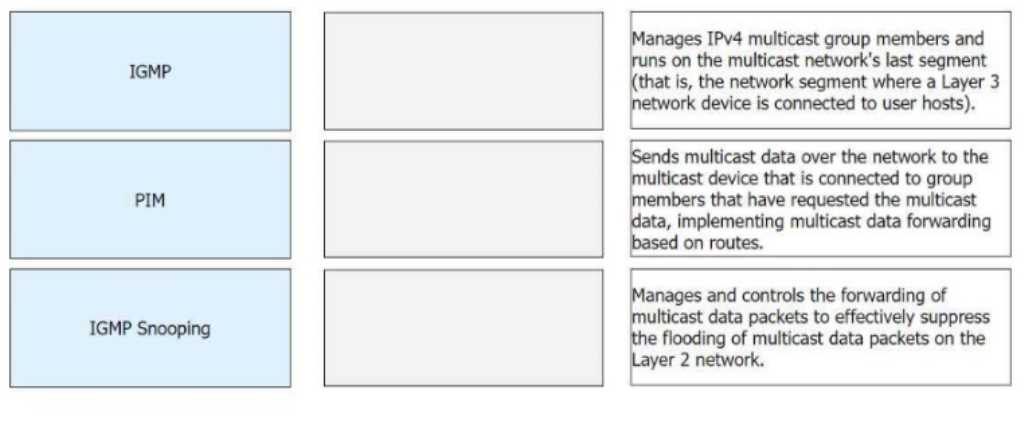
DRAG DROP Match the following IPv4 multicast protocols with the corresponding functions.
Drag & Drop
Discussion
Makes sense with IGMP for group membership, PIM for multicast routing, IGMP Snooping to prevent L2 flooding.
IGMP -> group membership, PIM -> multicast forwarding based on routes, IGMP Snooping -> controls L2 flooding. Had something like this in a mock but I usually mix up IGMP and Snooping since both deal with membership. Pretty sure this is right, correct me if I'm off.
IGMP → manages group membership at host segment, PIM → multicast routing via Layer 3, IGMP Snooping → controls L2 flooding. IGMP and Snooping can get mixed up since both watch membership but only Snooping works at switch level. Think this is spot on. Anyone disagree?
Yeah, saw a similar question on another practice set. I'd put IGMP for controlling L2 flooding, PIM for handling group membership at the last segment, and IGMP Snooping for forwarding multicast data based on routes. I mixed up IGMP and Snooping before since both see group joins. Kinda tricky, happy to be corrected.
Be respectful. No spam.
Q: 18
On an office network of an enterprise, OSPF is enabled on two directly connected routers. During
adjacency establishment, the state machine stays in the 2-way state. Which of the following
statements are not possible causes?
Options
Discussion
B tbh, router ID conflict is a trap here.
C and D. No explanation needed, those just aren't causes for 2-way issues in OSPF. Confident on this.
Be respectful. No spam.
Q: 19
ACLs are a common matching tool in routing policies. An ACL can be configured on a router to match
routes.
Options
Discussion
Guessing True for this one. I've seen ACLs used a lot in route-policies, not just filtering traffic.
Seen it in VRP as well, ACLs aren't just for packet filtering. They're definitely used for matching routes in policies. True.
Seriously, Huawei and their VRP options make this a headache. True
Be respectful. No spam.
Q: 20
In the OSPF protocol, intra-area route calculation involves only Router LSA, Network LSA, and
Summary LSA.
Options
Discussion
False . Intra-area OSPF uses just Router LSAs (Type 1) and Network LSAs (Type 2). Summary LSAs (Type 3) are for inter-area routing, not within the same area. Pretty sure that's what the RFC says too. Agree?
Guessing False. Summary LSAs are only for inter-area, trap is thinking they're used inside the area.
Probably False. Summary LSAs (Type 3) come into play between areas, not for intra-area SPF. Easy to miss that trap since 'involves' sounds broad, but for actual route calculation inside an area it's just Types 1 and 2. Anyone disagree?
Be respectful. No spam.
Question 11 of 20 · Page 2 / 2
