1. Rosen
E.
& Rekhter
Y. (2006). BGP/MPLS IP Virtual Private Networks (VPNs). RFC 4364. Internet Engineering Task Force.
Section 1
Introduction
Paragraph 4: "The P routers do not need to have any VPN routing information... This helps to ensure that the backbone can scale." This directly supports the correct answer (D) and refutes option (B).
Section 2
VRF
Paragraph 1: "If two VPNs use the same address space... a PE router must be able to install routes from both VPNs in its forwarding table..." This refutes option (A).
2. Davie
B.
& Farrel
A. (2008). MPLS: Next Steps. Morgan Kaufmann.
Chapter 3
Section 3.2.1
"The Roles of P and PE Routers": "The P routers are not aware of the VPNs and do not carry any customer routes. They simply switch labeled packets based on the information in their LFIBs." This confirms that P routers are unaware of customer routes (D).
3. Washington University in St. Louis
Course CSE 571S. (Fall 2013). MPLS and VPNs Lecture Notes.
Slide 25
"MPLS VPN Operation": Explicitly states
"P routers are not aware of VPN routes" and "PE routers peer with other PE routers using internal BGP (IBGP)." This supports answer (D) and clarifies the role of MP-BGP
refuting (B).

 A service provider wants to provide L3VPN for two customers (indicated by red and
green in the exhibit).
Referring to the exhibit, which statement is correct?
A service provider wants to provide L3VPN for two customers (indicated by red and
green in the exhibit).
Referring to the exhibit, which statement is correct?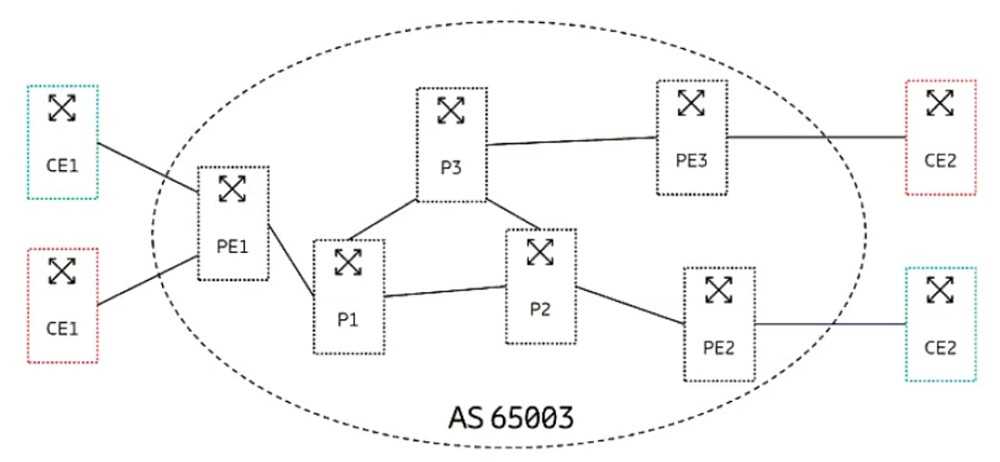 A service provider wants to provide L3VPN for two customers (indicated by red and
green in the exhibit).
Referring to the exhibit, which statement is correct?
A service provider wants to provide L3VPN for two customers (indicated by red and
green in the exhibit).
Referring to the exhibit, which statement is correct?