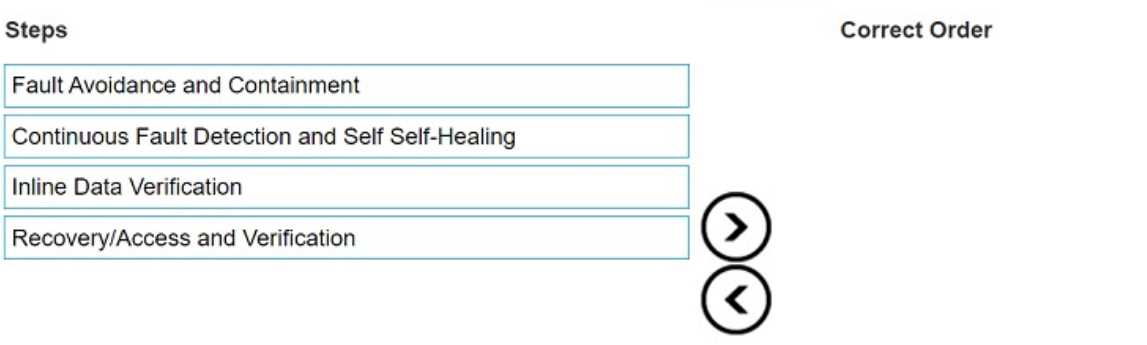
The correct order of operations for the Data Invulnerability Architecture (DIA) elements is as follows:
Fault Avoidance and Containment
Continuous Fault Detection and Self-Healing
Inline Data Verification
Recovery/Access and Verification
The Data Invulnerability Architecture (DIA) in Dell PowerProtect DD systems is designed to ensure
data integrity and resiliency throughout the data storage process. Here’s how each element plays a
role in this ordered sequence:
Fault Avoidance and Containment: This is the first layer of protection. DIA focuses on preventing
faults before they occur and containing any potential issues, ensuring that faults do not propagate
within the system. This stage is critical as it forms the foundational protection layer.
Continuous Fault Detection and Self-Healing: After implementing containment, the system
continuously monitors for faults. It actively identifies and mitigates issues through self-healing
mechanisms, addressing any detected errors autonomously to maintain data integrity.
Inline Data Verification: As data is written to storage, the inline data verification checks data integrity
on the fly. This step ensures that any corruption or errors in data are detected immediately, enabling
early intervention before data is permanently stored.
Recovery/Access and Verification: The final step ensures that, during data recovery, the integrity of
the data is verified before it is accessed or restored. This stage completes the DIA cycle by confirming
that data retrieved from storage is accurate and intact.
This ordered approach in DIA is designed to provide robust protection against data loss or corruption,
making Dell PowerProtect DD appliances highly reliable for data protection needs.