Step by Step Comprehensive Detailed Explanatio n:
Definition of Cost of Quality (CoQ):
CoQ is composed of four components:
Prevention Costs: Costs related to activities to prevent defects (e.g., training, quality planning).
Appraisal Costs: Costs associated with evaluating products to ensure defect-free delivery (e.g.,
testing).
Internal Failure Costs: Costs due to defects found before delivery to the customer (e.g., rework).
External Failure Costs: Costs from defects discovered after delivery (e.g., warranty claims, reputation
damage).
Calculation Process:
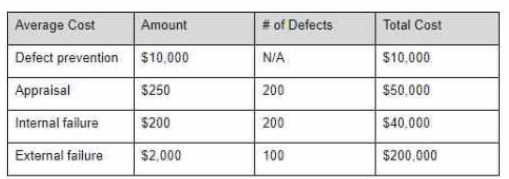
Defect Prevention Cost: Given as $10,000 (fixed).
Appraisal Cost: $250 per defect for 200 defects = 250×200=50,000250 \times 200 =
50,000250×200=50,000.
Internal Failure Cost: $200 per defect for 200 defects = 200×200=40,000200 \times 200 =
40,000200×200=40,000.
External Failure Cost: $2,000 per defect for 100 defects = 2,000×100=200,0002,000 \times 100 =
200,0002,000×100=200,000.
Total CoQ:
Adding all costs together:
Total CoQ=10,000+50,000+40,000+200,000=300,000.\text{Total CoQ} = 10,000 + 50,000 + 40,000 +
200,000 = 300,000.Total CoQ=10,000+50,000+40,000+200,000=300,000.
Correct Answer and Justification:
The total cost is $300,000, making Option A the correct answer.
Reference and Documentation from Advanced Test Management:
ISTQB Advanced Test Management Syllabus v3.0, Section 2.2.2: This section emphasizes
understanding and calculating the cost of quality by segregating it into the four components as seen
above .
ATM Sample Exam Questions 2024 (Example Calculations): Highlights similar numerical examples to
calculate CoQ .
ISTQB Exam Structure Rules v1.9: Ensures alignment with K2-level understanding for cost analysis
scenarios in test management .