
Q: 8
DRAG DROP Rank the Hypertext Transfer protocol (HTTP) authentication types shows below in order of relative strength. Drag the authentication type on the correct positions on the right according to strength from weakest to strongest. 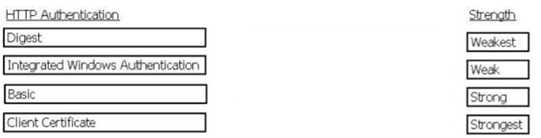
Drag & Drop
Discussion
Yeah, it's Basic then Digest then Integrated Windows Auth then Client Certificate.
Basic -> Weakest, Digest -> Weak, Integrated Windows Auth -> Strong, Client Certificate -> Strongest
Looks right to me based on the CISSP official guide and most practice tests. Basic is weakest, then Digest, IWA (Kerberos/NTLMv2) is stronger, and Client Certificate tops the list. If you want to double-check, the official CBK covers this mapping clearly.
- Basic → Weakest
- Digest → Weak
- Integrated Windows Authentication → Strong
- Client Certificate → Strongest
Basic → Weakest, Digest → Weak, Integrated Windows Auth → Strong, Client Certificate → Strongest
Pretty sure Karan swapped Digest and Integrated Windows Auth. Integrated Windows Auth uses Kerberos or NTLMv2 which is stronger than Digest, which just hashes creds with MD5. So ordering should be: Basic, Digest, Integrated Windows Auth, Client Certificate. Trap here is thinking Digest is stronger than IWA.
Nice, that's the order I remember too: Basic, Digest, Integrated Windows Auth, then Client Certificate for strongest. No explanation needed here.
Basic → Weakest, Digest → Weak, Integrated Windows Auth → Strong, Client Certificate → Strongest. That's the typical CISSP ranking.
Same order I see in the official guide and most practice exams: Basic, Digest, Integrated Windows Authentication, then Client Certificate as strongest. If you check the exam outline or CISSP study books it matches up.
Some folks miss that Digest is actually stronger than Basic but still not as robust as Integrated Windows Auth. So it's Basic -> Digest -> Integrated Windows Auth -> Client Certificate. If they ask about default configs, this order makes sense I think.
I see why everyone orders it Basic, Digest, IWA, Client Certificate. Base64 for Basic is barely anything, Digest does add a hash but MD5 isn't great these days. IWA using Kerberos or NTLMv2 is definitely stronger, PKI certs top it all off. Pretty sure this matches CISSP intent unless they're asking about legacy only.
Be respectful. No spam.
