
DRAG DROP Match the name of access control model with its associated restriction. Drag each access control model to its appropriate restriction access on the right. 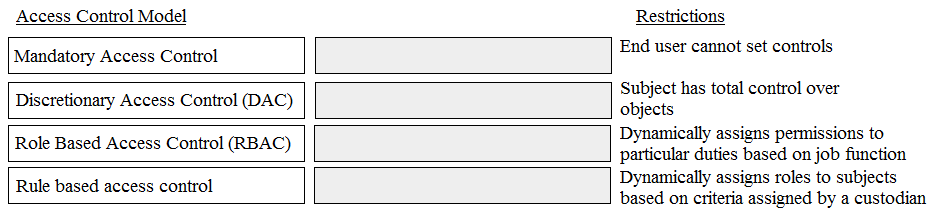
Actually, it's MAC to end user cannot set controls, DAC to subject has total control, RBAC to permissions by job function, Rule-based to roles by custodian. Easy to flip RBAC and Rule-based if you go too fast. Pretty sure that's correct from similar exam questions.
Pretty classic CISSP drag-and-drop. I'd map it:
Mandatory Access Control → End user cannot set controls,
Discretionary Access Control (DAC) → Subject has total control over objects,
Role Based Access Control (RBAC) → Dynamically assigns permissions to particular duties based on job function,
Rule based access control → Dynamically assigns roles to subjects based on criteria assigned by a custodian.
I think that's spot-on for the way the terms are usually defined, though I know RBAC and Rule-based get mixed up sometimes if you're not watching the "dynamic" cue. Let me know if you see it different!
I see the confusion, but pretty sure it's MAC for end user can't set controls, DAC for subject has total control over objects, RBAC for job function duties, Rule-based for roles by custodian criteria. That's how official CISSP guides usually match them up. Correct me if you see it differently!
