1. NFPA 101®, Life Safety Code® Handbook, 2021 Edition, Commentary on Section 7.5.1.6, Exhibit 7.51. This source illustrates the standard method for measuring a dead-end corridor from its terminus to the centerline of the intersecting corridor, which provides a choice of egress paths. The provided drawing's dimension (31 ft 6 in.) deviates from this by measuring to the far wall, but it is the only explicit dimension given for that section.
2. Ching, F. D. K. (2014). Architectural Graphics. John Wiley & Sons. Chapter 3, "Architectural Drawing Systems," pp. 98-101. This text explains the conventions of architectural drawings, including the principle that explicit, written dimensions on a plan take precedence for interpretation over scaled measurements or calculations based on other, potentially conflicting, dimensions.
3. SFPE Handbook of Fire Protection Engineering, 5th Edition (2016). Chapter 54, "Egress System Design," Section 54.4.3. This chapter discusses the components of the means of egress, including corridors, and the importance of correctly interpreting design documents (like the provided exhibit) to evaluate compliance with code requirements such as dead-end limits.

 In the figure what is the approximate length of the dead end corridor?
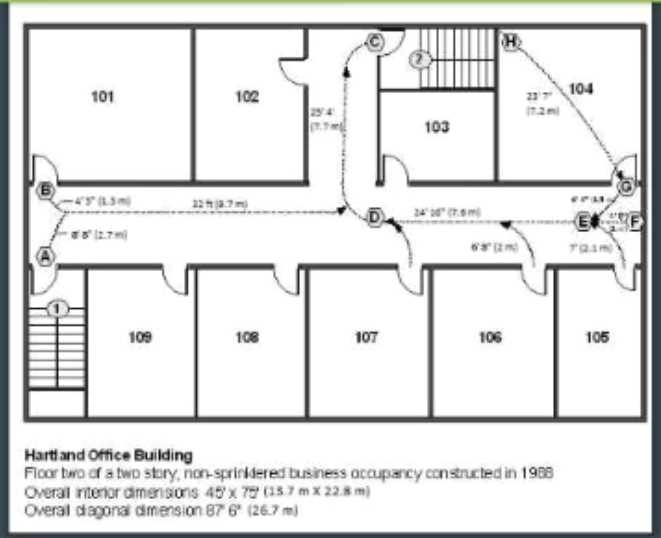 In the figure what is the approximate length of the dead end corridor?