Source: Cisco. (2019). Enterprise Mobility 8.5 Design Guide.
Reference: Chapter 2, "WLAN RF Design Considerations," section "Channel Reuse."
Content: This guide details that in the 2.4 GHz band, only channels 1, 6, and 11 are non-overlapping. A fundamental principle of WLAN RF design is to create a channel reuse plan where "no two adjacent cells operate on the same channel." When same-channel cells are adjacent, as shown between zones 3 and 6, it results in co-channel interference, which "limits the performance and capacity" of the network.
Source: Carnegie Mellon University. (2017). 15-441: Networking and the Internet, Lecture 21: Wireless.
Reference: Slide 42-44, "Interference."
Content: This university courseware explains that sources of interference in 802.11 include other APs. It explicitly diagrams how adjacent APs must use different channels (e.g., 1, 6, 11) to avoid interference. When APs on the same channel are too close, their coverage overlaps, and a client in that overlap region cannot reliably communicate, as the CSMA/CA (Carrier Sense Multiple Access with Collision Avoidance) mechanism is compromised.
Source: Gurevitch, A., He, A., & Zhang, J. (2007). The impact of co-channel interference on 802.11n network performance. 2007 IEEE International Conference on Communications.
DOI: https://doi.org/10.1109/ICC.2007.94
Content: This peer-reviewed publication analyzes the effects of CCI. It confirms that as co-channel interference increases (which occurs when same-channel APs are placed near each other), the "packet error rate increases significantly," and overall network throughput is "severely degraded." This degradation manifests to a user as intermittent or dropped connections.

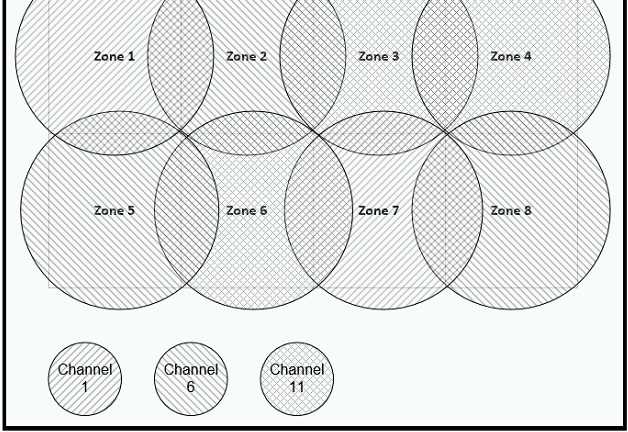 Between which zones do wireless users expect to experience intermittent connectivity?