
Q: 5
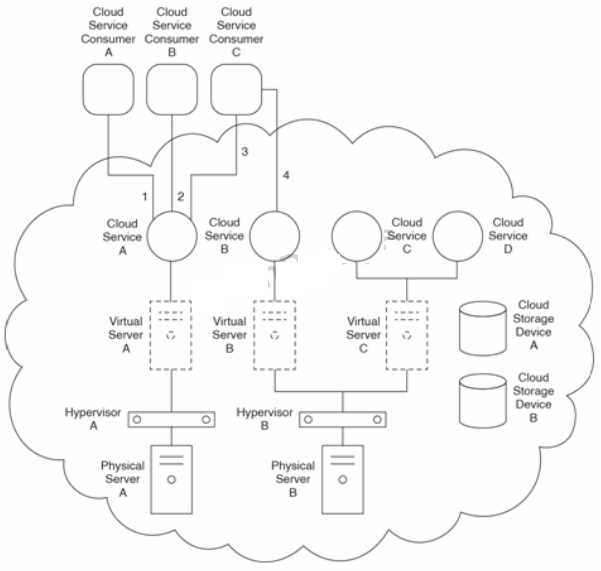
Cloud Sen/ice A is hosted by Virtual Server A, which is hosted by Hypervisor A on Physical Server A.
Cloud Service B is hosted by Virtual Server B. Virtual Server C hosts Cloud Services C and D.
Virtual Server B and Virtual Server C are hosted by Hypervisor B on Physical Server B.
Cloud Service Consumer A accesses Cloud Service A (1). Cloud Service Consumer B accesses Cloud
Service A (2). Cloud Service Consumer C accesses Cloud Service A (3) and then accesses Cloud Service
B (4).
 Cloud Service Consumers A, B and C simultaneously access Cloud Service A. Cloud Service Consumer
C receives a runtime exception and its request for access is rejected. It is determined that Cloud
Service Consumer C attempted to upload a large amount of input data for Cloud Service A, which
exceeded the bandwidth threshold of the virtual network. The cloud architecture needs to be
improved to avoid this from happening again.
Cloud Service Consumer C's repeated access of Cloud Service B imposes workloads that are large and
highly unpredictable. After some time, Cloud Service B begins to delay its responses and sometimes
times out entirely. The cloud resource administrator discovers that Virtual Server B is unstable and
close to failure primarily because its CPU and memory resources are being used to their maximum
capacity.
Cloud Services C and D are being positioned as SaaS products for use by a range of cloud consumer
organizations. After their initial release, they begin to quickly use up the available memory in Virtual
Server C, primarily because of the large amounts of state and session data they need to place into
memory for extended periods.
Which of the following statements lists the patterns that can be applied to solve these three
requirements and problems?
Cloud Service Consumers A, B and C simultaneously access Cloud Service A. Cloud Service Consumer
C receives a runtime exception and its request for access is rejected. It is determined that Cloud
Service Consumer C attempted to upload a large amount of input data for Cloud Service A, which
exceeded the bandwidth threshold of the virtual network. The cloud architecture needs to be
improved to avoid this from happening again.
Cloud Service Consumer C's repeated access of Cloud Service B imposes workloads that are large and
highly unpredictable. After some time, Cloud Service B begins to delay its responses and sometimes
times out entirely. The cloud resource administrator discovers that Virtual Server B is unstable and
close to failure primarily because its CPU and memory resources are being used to their maximum
capacity.
Cloud Services C and D are being positioned as SaaS products for use by a range of cloud consumer
organizations. After their initial release, they begin to quickly use up the available memory in Virtual
Server C, primarily because of the large amounts of state and session data they need to place into
memory for extended periods.
Which of the following statements lists the patterns that can be applied to solve these three
requirements and problems?
 Cloud Service Consumers A, B and C simultaneously access Cloud Service A. Cloud Service Consumer
C receives a runtime exception and its request for access is rejected. It is determined that Cloud
Service Consumer C attempted to upload a large amount of input data for Cloud Service A, which
exceeded the bandwidth threshold of the virtual network. The cloud architecture needs to be
improved to avoid this from happening again.
Cloud Service Consumer C's repeated access of Cloud Service B imposes workloads that are large and
highly unpredictable. After some time, Cloud Service B begins to delay its responses and sometimes
times out entirely. The cloud resource administrator discovers that Virtual Server B is unstable and
close to failure primarily because its CPU and memory resources are being used to their maximum
capacity.
Cloud Services C and D are being positioned as SaaS products for use by a range of cloud consumer
organizations. After their initial release, they begin to quickly use up the available memory in Virtual
Server C, primarily because of the large amounts of state and session data they need to place into
memory for extended periods.
Which of the following statements lists the patterns that can be applied to solve these three
requirements and problems?
Cloud Service Consumers A, B and C simultaneously access Cloud Service A. Cloud Service Consumer
C receives a runtime exception and its request for access is rejected. It is determined that Cloud
Service Consumer C attempted to upload a large amount of input data for Cloud Service A, which
exceeded the bandwidth threshold of the virtual network. The cloud architecture needs to be
improved to avoid this from happening again.
Cloud Service Consumer C's repeated access of Cloud Service B imposes workloads that are large and
highly unpredictable. After some time, Cloud Service B begins to delay its responses and sometimes
times out entirely. The cloud resource administrator discovers that Virtual Server B is unstable and
close to failure primarily because its CPU and memory resources are being used to their maximum
capacity.
Cloud Services C and D are being positioned as SaaS products for use by a range of cloud consumer
organizations. After their initial release, they begin to quickly use up the available memory in Virtual
Server C, primarily because of the large amounts of state and session data they need to place into
memory for extended periods.
Which of the following statements lists the patterns that can be applied to solve these three
requirements and problems?Options
Discussion
No comments yet. Be the first to comment.
Be respectful. No spam.
