
Q: 2
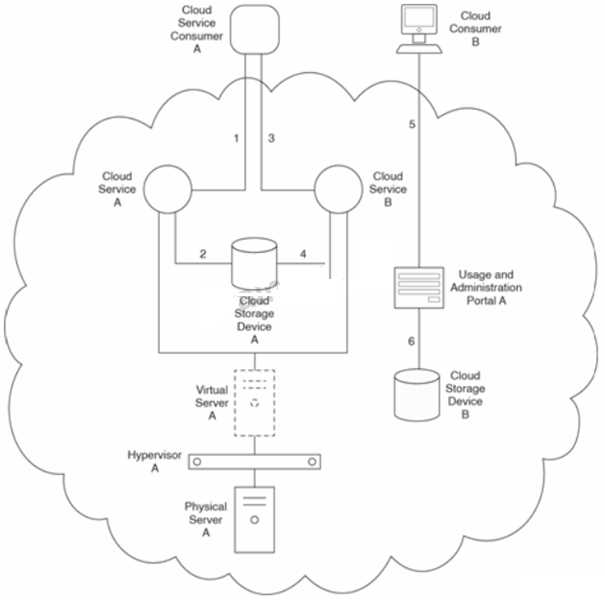
Cloud Service A and Cloud Service B perform different functions but both share access to Cloud
Storage Device A when fulfilling requests from cloud service consumers that require data access.
Cloud Services A and B are hosted by Virtual Server A, which is hosted by Hypervisor A on Physical
Server A.
Cloud Service Consumer A accesses Cloud Service A to issue a request for data (1). Cloud Service A
queries a database in Cloud Storage Device A to retrieve the data (2). Upon receiving the requested
data, Cloud Service Consumer A combines it with additional data to form a new collection of data.
Cloud Service Consumer A then accesses Cloud Service B and provides it with the new data (3). Cloud
Service B accesses a different database in Cloud Storage Device A to store the new data (4). Cloud
Consumer B accesses the usage and administration portal to upload new data (5). The data is
uploaded to Cloud Storage Device B (6).
Cloud Service Consumer A belongs to Organization A. Cloud Consumer B belongs to Organization B.
 Cloud Service A is a SaaS product offered by the cloud provider to the general public, and is therefore
used by numerous cloud consumers from different organizations at different times. Cloud Service B is
also a SaaS product as part of the same overall solution as Cloud Service A.
However, because a given cloud service consumer only needs to access Cloud Service B when the
data it receives from Cloud Service A meets certain criteria, it is not used nearly as much as Cloud
Service A. Cloud Service A currently has a hard threshold allowing no more than 10 concurrent
instances of it to exist at once. One day, Cloud Service Consumer A attempts to access Cloud Service
A as the eleventh cloud service consumer, and is predictably rejected.
Cloud Service Consumer A belongs to Organization A, one of the cloud provider's most important
customers. Therefore, when Organization A complains about not being able to access Cloud Service A
during peak usage times, the cloud provider agrees to provide a solution.
As a result of a natural disaster, the cloud provider's data center that houses Physical Server A
becomes unexpectedly unavailable. Physical Server A subsequently becomes unavailable for nearly
two days. This outage exceeds what the cloud provider guaranteed in its original SLA and the cloud
provider agrees to not charge Organization for usage fees for an entire month as compensation.
However, the unavailability of Physical Server A had a significant impact on Organization As business,
resulting in financial loss and loss of confidence of its clients.
Organization A informs the cloud provider that it cannot continue working with this cloud unless the
cloud provider can guarantee that the availability of Physical Server A will no longer be dependent on
a single data center or a single geographic region.
Organization B receives its latest monthly invoice from the cloud provider and discovers that the
charges are identical to the invoice it received last month, even though the usage and administration
portal shows that its data usage is a third less. They bring this issue to the attention of the cloud
provider and are informed that they are currently subscribed to a fixed-allocation plan.
The cloud provider explains that in order to get them on a plan whereby they are charged only for
actual data usage, Cloud Storage Device B would need to be upgraded and a system capable of
tracking runtime usage would need to be established. Organization B asks the cloud provider to make
these changes.
Which of the following statements provides a solution that can address Organization A's and
Organization B's issues?
Cloud Service A is a SaaS product offered by the cloud provider to the general public, and is therefore
used by numerous cloud consumers from different organizations at different times. Cloud Service B is
also a SaaS product as part of the same overall solution as Cloud Service A.
However, because a given cloud service consumer only needs to access Cloud Service B when the
data it receives from Cloud Service A meets certain criteria, it is not used nearly as much as Cloud
Service A. Cloud Service A currently has a hard threshold allowing no more than 10 concurrent
instances of it to exist at once. One day, Cloud Service Consumer A attempts to access Cloud Service
A as the eleventh cloud service consumer, and is predictably rejected.
Cloud Service Consumer A belongs to Organization A, one of the cloud provider's most important
customers. Therefore, when Organization A complains about not being able to access Cloud Service A
during peak usage times, the cloud provider agrees to provide a solution.
As a result of a natural disaster, the cloud provider's data center that houses Physical Server A
becomes unexpectedly unavailable. Physical Server A subsequently becomes unavailable for nearly
two days. This outage exceeds what the cloud provider guaranteed in its original SLA and the cloud
provider agrees to not charge Organization for usage fees for an entire month as compensation.
However, the unavailability of Physical Server A had a significant impact on Organization As business,
resulting in financial loss and loss of confidence of its clients.
Organization A informs the cloud provider that it cannot continue working with this cloud unless the
cloud provider can guarantee that the availability of Physical Server A will no longer be dependent on
a single data center or a single geographic region.
Organization B receives its latest monthly invoice from the cloud provider and discovers that the
charges are identical to the invoice it received last month, even though the usage and administration
portal shows that its data usage is a third less. They bring this issue to the attention of the cloud
provider and are informed that they are currently subscribed to a fixed-allocation plan.
The cloud provider explains that in order to get them on a plan whereby they are charged only for
actual data usage, Cloud Storage Device B would need to be upgraded and a system capable of
tracking runtime usage would need to be established. Organization B asks the cloud provider to make
these changes.
Which of the following statements provides a solution that can address Organization A's and
Organization B's issues?
 Cloud Service A is a SaaS product offered by the cloud provider to the general public, and is therefore
used by numerous cloud consumers from different organizations at different times. Cloud Service B is
also a SaaS product as part of the same overall solution as Cloud Service A.
However, because a given cloud service consumer only needs to access Cloud Service B when the
data it receives from Cloud Service A meets certain criteria, it is not used nearly as much as Cloud
Service A. Cloud Service A currently has a hard threshold allowing no more than 10 concurrent
instances of it to exist at once. One day, Cloud Service Consumer A attempts to access Cloud Service
A as the eleventh cloud service consumer, and is predictably rejected.
Cloud Service Consumer A belongs to Organization A, one of the cloud provider's most important
customers. Therefore, when Organization A complains about not being able to access Cloud Service A
during peak usage times, the cloud provider agrees to provide a solution.
As a result of a natural disaster, the cloud provider's data center that houses Physical Server A
becomes unexpectedly unavailable. Physical Server A subsequently becomes unavailable for nearly
two days. This outage exceeds what the cloud provider guaranteed in its original SLA and the cloud
provider agrees to not charge Organization for usage fees for an entire month as compensation.
However, the unavailability of Physical Server A had a significant impact on Organization As business,
resulting in financial loss and loss of confidence of its clients.
Organization A informs the cloud provider that it cannot continue working with this cloud unless the
cloud provider can guarantee that the availability of Physical Server A will no longer be dependent on
a single data center or a single geographic region.
Organization B receives its latest monthly invoice from the cloud provider and discovers that the
charges are identical to the invoice it received last month, even though the usage and administration
portal shows that its data usage is a third less. They bring this issue to the attention of the cloud
provider and are informed that they are currently subscribed to a fixed-allocation plan.
The cloud provider explains that in order to get them on a plan whereby they are charged only for
actual data usage, Cloud Storage Device B would need to be upgraded and a system capable of
tracking runtime usage would need to be established. Organization B asks the cloud provider to make
these changes.
Which of the following statements provides a solution that can address Organization A's and
Organization B's issues?
Cloud Service A is a SaaS product offered by the cloud provider to the general public, and is therefore
used by numerous cloud consumers from different organizations at different times. Cloud Service B is
also a SaaS product as part of the same overall solution as Cloud Service A.
However, because a given cloud service consumer only needs to access Cloud Service B when the
data it receives from Cloud Service A meets certain criteria, it is not used nearly as much as Cloud
Service A. Cloud Service A currently has a hard threshold allowing no more than 10 concurrent
instances of it to exist at once. One day, Cloud Service Consumer A attempts to access Cloud Service
A as the eleventh cloud service consumer, and is predictably rejected.
Cloud Service Consumer A belongs to Organization A, one of the cloud provider's most important
customers. Therefore, when Organization A complains about not being able to access Cloud Service A
during peak usage times, the cloud provider agrees to provide a solution.
As a result of a natural disaster, the cloud provider's data center that houses Physical Server A
becomes unexpectedly unavailable. Physical Server A subsequently becomes unavailable for nearly
two days. This outage exceeds what the cloud provider guaranteed in its original SLA and the cloud
provider agrees to not charge Organization for usage fees for an entire month as compensation.
However, the unavailability of Physical Server A had a significant impact on Organization As business,
resulting in financial loss and loss of confidence of its clients.
Organization A informs the cloud provider that it cannot continue working with this cloud unless the
cloud provider can guarantee that the availability of Physical Server A will no longer be dependent on
a single data center or a single geographic region.
Organization B receives its latest monthly invoice from the cloud provider and discovers that the
charges are identical to the invoice it received last month, even though the usage and administration
portal shows that its data usage is a third less. They bring this issue to the attention of the cloud
provider and are informed that they are currently subscribed to a fixed-allocation plan.
The cloud provider explains that in order to get them on a plan whereby they are charged only for
actual data usage, Cloud Storage Device B would need to be upgraded and a system capable of
tracking runtime usage would need to be established. Organization B asks the cloud provider to make
these changes.
Which of the following statements provides a solution that can address Organization A's and
Organization B's issues?Options
Discussion
No comments yet. Be the first to comment.
Be respectful. No spam.
