
Q: 10
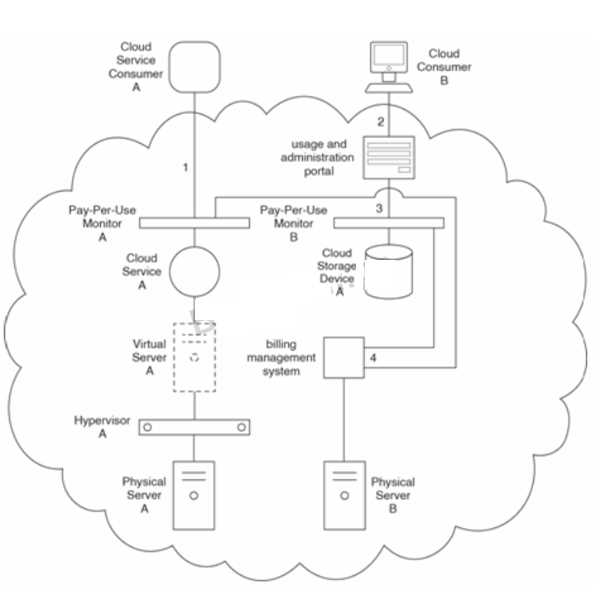
Cloud Service A is hosted by Virtual Server A, which is hosted by Hypervisor A that resides on
Physical Server A. Cloud Storage Device A is used to store media library data that is continuously
replicated with a redundant, secondary implementation of Cloud Storage A (not shown). Access to
Cloud Service A is monitored by Pay-Per-Use Monitor A. Access to Cloud Storage Device A is
monitored by Pay-Per-Use Monitor B. Pay-Per-Use Monitors A and B capture billing-related usage
data that is forwarded to a billing management system that is hosted by Physical Server B.
Cloud Service Consumer A accesses Cloud Service A and the usage data is captured by Pay-Per-Use
Monitor A (1). Cloud Consumer B accesses Cloud Storage Device A via a usage and administration
portal that it uses to upload media data (2). This usage is captured by Pay-Per-Use Monitor B (3). Pay-
Per-Use Monitors A and B store collected usage data in the billing management system (4), which is
later used by the cloud provider to bill for the usage of Cloud Service A and Cloud Storage Device A.
 Each service instance of Cloud Service A requires a virtual server with 2 virtual CPUs and 4 GBs of
RAM at a package price of $2.00 for each initial invocation and an additional $0.50 for each
consecutive 60 seconds of usage. Cloud Service Consumer A accesses Cloud Service A twice in one
day. The two exchanges with Cloud Service A last 60 seconds and 120 seconds. For that one day, the
organization that owns Cloud Service Consumer A is billed $6.50, which it determines is incorrect.
After complaining to the cloud provider, it is discovered that the rapid provisioning system
responsible for provisioning instances of Cloud Service A is not de-provisioning Cloud Service A when
Cloud Service Consumer A indicates it has completed an exchange. Instead, Cloud Service A is de-
provisioned after a 60 second timeout that occurs after Cloud Service Consumer A is completed with
an exchange.
Storage space on Cloud Storage Device A can only be purchased in units of terabytes (TBs), with each
TB costing $1 per day. Cloud Consumer B purchases 5 TBs of storage space on day 1 and stores 5 TBs
of data on days 6 and 7. Cloud Consumer B was expecting to be billed $10.00, but is billed $35. After
raising a complaint, Cloud Consumer B is informed by the cloud provider that cloud consumers are
billed based on the allocation of storage space, regardless of how much storage space they actually
use.
Which of the following statements describes a solution that can update the cloud architecture to
avoid these billing-related problems and discrepancies?
Each service instance of Cloud Service A requires a virtual server with 2 virtual CPUs and 4 GBs of
RAM at a package price of $2.00 for each initial invocation and an additional $0.50 for each
consecutive 60 seconds of usage. Cloud Service Consumer A accesses Cloud Service A twice in one
day. The two exchanges with Cloud Service A last 60 seconds and 120 seconds. For that one day, the
organization that owns Cloud Service Consumer A is billed $6.50, which it determines is incorrect.
After complaining to the cloud provider, it is discovered that the rapid provisioning system
responsible for provisioning instances of Cloud Service A is not de-provisioning Cloud Service A when
Cloud Service Consumer A indicates it has completed an exchange. Instead, Cloud Service A is de-
provisioned after a 60 second timeout that occurs after Cloud Service Consumer A is completed with
an exchange.
Storage space on Cloud Storage Device A can only be purchased in units of terabytes (TBs), with each
TB costing $1 per day. Cloud Consumer B purchases 5 TBs of storage space on day 1 and stores 5 TBs
of data on days 6 and 7. Cloud Consumer B was expecting to be billed $10.00, but is billed $35. After
raising a complaint, Cloud Consumer B is informed by the cloud provider that cloud consumers are
billed based on the allocation of storage space, regardless of how much storage space they actually
use.
Which of the following statements describes a solution that can update the cloud architecture to
avoid these billing-related problems and discrepancies?
 Each service instance of Cloud Service A requires a virtual server with 2 virtual CPUs and 4 GBs of
RAM at a package price of $2.00 for each initial invocation and an additional $0.50 for each
consecutive 60 seconds of usage. Cloud Service Consumer A accesses Cloud Service A twice in one
day. The two exchanges with Cloud Service A last 60 seconds and 120 seconds. For that one day, the
organization that owns Cloud Service Consumer A is billed $6.50, which it determines is incorrect.
After complaining to the cloud provider, it is discovered that the rapid provisioning system
responsible for provisioning instances of Cloud Service A is not de-provisioning Cloud Service A when
Cloud Service Consumer A indicates it has completed an exchange. Instead, Cloud Service A is de-
provisioned after a 60 second timeout that occurs after Cloud Service Consumer A is completed with
an exchange.
Storage space on Cloud Storage Device A can only be purchased in units of terabytes (TBs), with each
TB costing $1 per day. Cloud Consumer B purchases 5 TBs of storage space on day 1 and stores 5 TBs
of data on days 6 and 7. Cloud Consumer B was expecting to be billed $10.00, but is billed $35. After
raising a complaint, Cloud Consumer B is informed by the cloud provider that cloud consumers are
billed based on the allocation of storage space, regardless of how much storage space they actually
use.
Which of the following statements describes a solution that can update the cloud architecture to
avoid these billing-related problems and discrepancies?
Each service instance of Cloud Service A requires a virtual server with 2 virtual CPUs and 4 GBs of
RAM at a package price of $2.00 for each initial invocation and an additional $0.50 for each
consecutive 60 seconds of usage. Cloud Service Consumer A accesses Cloud Service A twice in one
day. The two exchanges with Cloud Service A last 60 seconds and 120 seconds. For that one day, the
organization that owns Cloud Service Consumer A is billed $6.50, which it determines is incorrect.
After complaining to the cloud provider, it is discovered that the rapid provisioning system
responsible for provisioning instances of Cloud Service A is not de-provisioning Cloud Service A when
Cloud Service Consumer A indicates it has completed an exchange. Instead, Cloud Service A is de-
provisioned after a 60 second timeout that occurs after Cloud Service Consumer A is completed with
an exchange.
Storage space on Cloud Storage Device A can only be purchased in units of terabytes (TBs), with each
TB costing $1 per day. Cloud Consumer B purchases 5 TBs of storage space on day 1 and stores 5 TBs
of data on days 6 and 7. Cloud Consumer B was expecting to be billed $10.00, but is billed $35. After
raising a complaint, Cloud Consumer B is informed by the cloud provider that cloud consumers are
billed based on the allocation of storage space, regardless of how much storage space they actually
use.
Which of the following statements describes a solution that can update the cloud architecture to
avoid these billing-related problems and discrepancies?Options
Discussion
No comments yet. Be the first to comment.
Be respectful. No spam.
