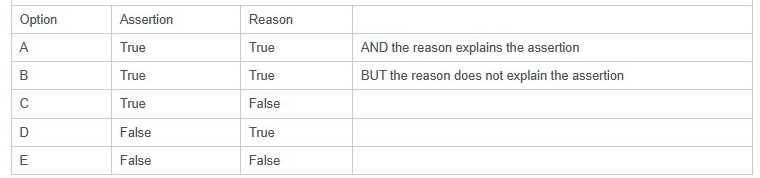
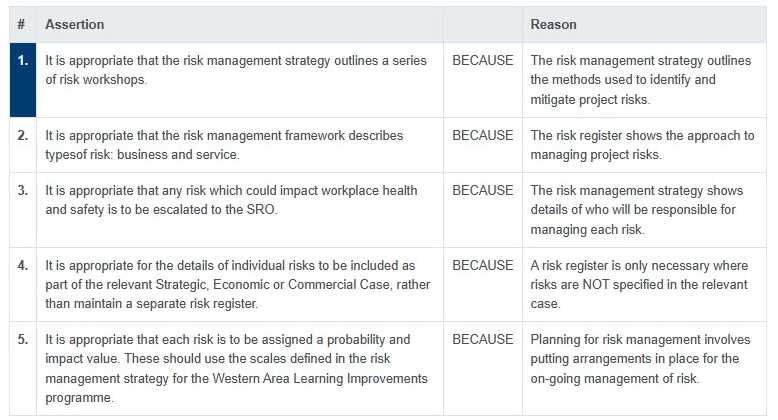
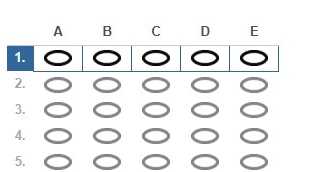
Let's evaluate each assertion and reason to identify the appropriate option for lines 1 to 5: Assertion: It is appropriate that the risk management strategy outlines a series of risk workshops. Reason: The risk management strategy outlines the methods used to identify and mitigate project risks. Appropriate Option: A (True, True, AND the reason explains the assertion) Assertion: It is appropriate that the risk management framework describes types of risk: business and service. Reason: The risk register shows the approach to managing project risks. Appropriate Option: B (True, True, BUT the reason does not explain the assertion) Assertion: It is appropriate that any risk which could impact workplace health and safety is to be escalated to the SRO. Reason: The risk management strategy shows details of who will be responsible for managing each risk. Appropriate Option: A (True, True, AND the reason explains the assertion) Assertion: It is appropriate for the details of individual risks to be included as part of the relevant Strategic, Economic or Commercial Case, rather than maintain a separate risk register. Reason: A risk register is only necessary where risks are NOT specified in the relevant case. Appropriate Option: E (False, False) Assertion: It is appropriate that each risk is to be assigned a probability and impact value. These should use the scales defined in the risk management strategy for the Western Area Learning Improvements programme. Reason: Planning for risk management involves putting arrangements in place for the on-going management of risk. Appropriate Option: A (True, True, AND the reason explains the assertion) These options were chosen based on the logical connection between the assertions and the reasons provided, considering the typical content of risk management strategies and frameworks in project and program management.