Q: 1
DRAG DROP Match the Azure service to the correct description. Instructions: To answer, drag the appropriate Azure service from the column on the left to its description on the right. Each service may be used once, more than once, or not at all NOTE: Each correct match is worth one point. 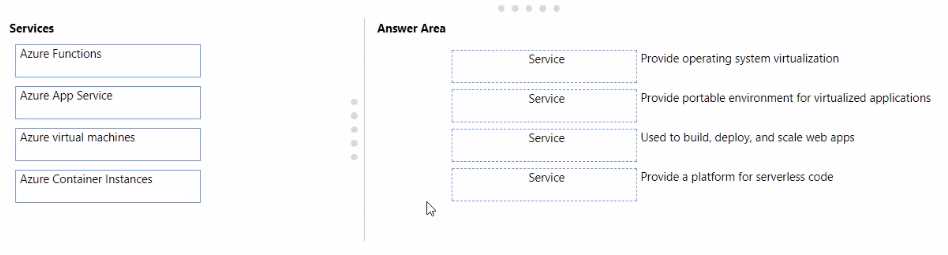
Drag & Drop
Discussion
Seen a similar mapping in practice sets. Virtual machines is traditional IaaS, container instances for quick containers, app service for web apps, and functions is serverless compute. Order is:
Bucket 1: Azure virtual machines
Bucket 2: Azure Container Instances.
Bucket 3: Azure App Service
Bucket 4: Azure Functions. Makes sense from an architecture perspective, but let me know if you spot any mismatches!
Bucket 1: Azure virtual machines, Bucket 2: Azure Container Instances, Bucket 3: Azure App Service, Bucket 4: Azure Functions. Don’t fall for the trap where App Service and Functions are swapped-some practice questions word those really close. I’m pretty sure this is right unless the buckets mention serverless directly. Disagree?
Bucket 1: Azure virtual machines, Bucket 2: Azure Container Instances, Bucket 3: Azure App Service, Bucket 4: Azure Functions. That's the order I picked too. VMs give you full control, Containers for isolated app runs, App Service is managed web hosting, and Functions is for event-based code. Pretty sure this is spot on but open to corrections!
Bucket 1: Azure virtual machines, Bucket 2: Azure Container Instances, Bucket 3: Azure App Service, Bucket 4: Azure Functions. Watch out, if the descriptions ever swap 'web app' with 'event-driven', that would flip buckets 3 and 4!
I don’t think switching App Service and Functions is right unless the bucket says something about serverless or triggers. More likely, it’s VM for IaaS, Containers for running isolated workloads, App Service for web apps, then Functions for event-driven stuff. Some practice exams try to trip you up by rewording web app/serverless.
Bucket 1: Azure virtual machines, Bucket 2: Azure Container Instances, Bucket 3: Azure App Service, Bucket 4: Azure Functions. Official study guide covers these basics.
Bucket 1: Azure virtual machines, Bucket 2: Azure Container Instances, Bucket 3: Azure App Service, Bucket 4: Azure Functions. I don’t think App Service is the trap here even though Functions sometimes confuses people with APIs. This fits most exam reports but if the buckets mentioned “event-driven” I’d swap 3 and 4. Agree?
So tired of these Azure matching drags, it’s always: Bucket 1 VM, 2 Container Instances, 3 App Service, 4 Functions.
Bucket 1: Azure virtual machines, Bucket 2: Azure Container Instances, Bucket 3: Azure App Service, Bucket 4: Azure Functions. Only catch is if the descriptions mention "event-driven", then Functions might swap with App Service. Hard to tell without full question, but that's what I'd do.
VMs to Bucket 1, Containers Bucket 2, Functions Bucket 3, App Service Bucket 4. Saw something like this in the official practice test so I think this is decent but wouldn't hurt to check against the Microsoft Learn guide if you're unsure.
Be respectful. No spam.