
Q: 2
You have an Azure subscription that contains the resources shown in the following table.
 You plan to deploy an Azure Virtual Network NAT gateway named Gateway 1. The solution must
meet the following requirements:
• VM1 will access the internet by using its public IP address.
• VM2 will access the internet by using its public IP address.
• Administrative effort must be minimized.
You need to ensure that you can deploy Gateway1 to Vnet1.
What is the minimal number of subnets that Vnet1 must have?
You plan to deploy an Azure Virtual Network NAT gateway named Gateway 1. The solution must
meet the following requirements:
• VM1 will access the internet by using its public IP address.
• VM2 will access the internet by using its public IP address.
• Administrative effort must be minimized.
You need to ensure that you can deploy Gateway1 to Vnet1.
What is the minimal number of subnets that Vnet1 must have?
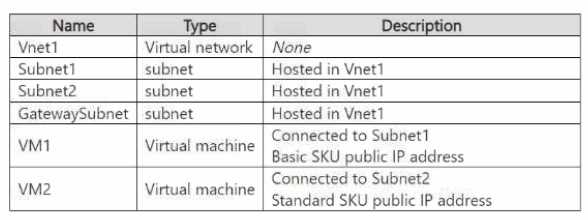 You plan to deploy an Azure Virtual Network NAT gateway named Gateway 1. The solution must
meet the following requirements:
• VM1 will access the internet by using its public IP address.
• VM2 will access the internet by using its public IP address.
• Administrative effort must be minimized.
You need to ensure that you can deploy Gateway1 to Vnet1.
What is the minimal number of subnets that Vnet1 must have?
You plan to deploy an Azure Virtual Network NAT gateway named Gateway 1. The solution must
meet the following requirements:
• VM1 will access the internet by using its public IP address.
• VM2 will access the internet by using its public IP address.
• Administrative effort must be minimized.
You need to ensure that you can deploy Gateway1 to Vnet1.
What is the minimal number of subnets that Vnet1 must have?Options
Discussion
Option C
Option C is it. B's a trap since each VM that needs to keep its public IP for outbound can't be in a NAT subnet, so you need separate subnets plus the required GatewaySubnet. Definitely four here, not three.
C . Each VM with public IP needs its own subnet to avoid NAT override, then an extra subnet for the NAT gateway and another for GatewaySubnet. Four total, not less. Let me know if I missed something.
Yeah, that lines up for me too. C
I don't think it's B, since VM1 and VM2 can't share a NAT subnet if they need separate public IP outbound. C.
C not 100% sure but that's what fits the NAT and public IP setup best. Anyone see another way?
Probably C here. VM1 and VM2 each need their own subnets to keep their public IP outbound, plus a subnet for NAT and the required GatewaySubnet. Minimal config with 4 subnets total.
C vs B here. Azure NAT gateway grabs all outbound from any subnet it's attached to, so VM1 and VM2 can't be in the NAT subnet or they'll lose their public IP outbound. That makes it a minimum of 4 subnets unless the two VMs could safely share, which isn't allowed by the requirements. Let me know if I missed something.
C tbh, but only because Azure NAT will intercept outbound traffic unless the VM is in its own subnet away from the NAT gateway. If VM1 and VM2 could safely share a subnet, maybe you could do it in 3, but the requirement usually means 4.
C
Agreed, you need 4 subnets to satisfy the NAT and public IP requirements for both VMs.
Be respectful. No spam.
