
DRAG DROP - You have an Azure subscription that contains the resources shown in the following table. 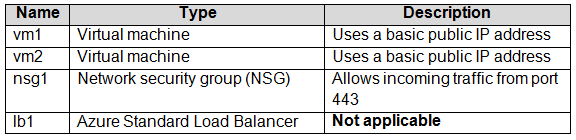 You need to load balance HTTPS connections to vm1 and vm2 by using lb1. Which three actions should you perform in sequence? To answer, move the appropriate actions from the list of actions to the answer area and arrange them in the correct order. Select and Place: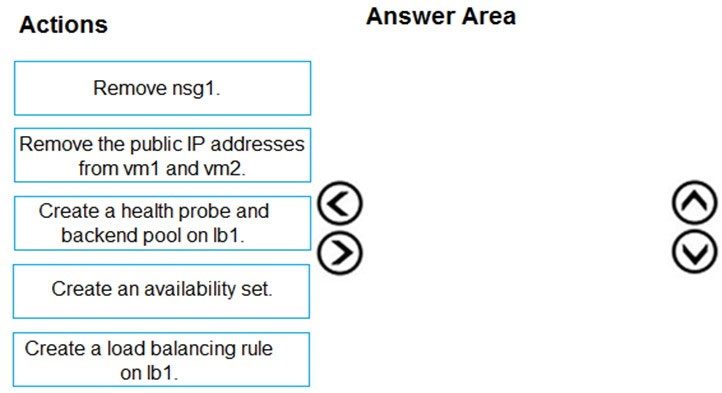
Looks like the right sequence is remove the public IPs from vm1 and vm2, create a health probe and backend pool on lb1, then add the load balancing rule. Standard LB can't work with VMs that have basic public IPs still attached. Saw a similar question on my last mock so I think that's correct but let me know if you see a catch.
This comes up a lot in labs and the official practice tests: remove public IPs from vm1/vm2 first, set up health probe and backend pool, then add the LB rule. Pretty sure that's the sequence from Microsoft docs but let me know if there's a different twist here.
- Remove public IP addresses from vm1 and vm2
- Create a health probe and backend pool on lb1
- Create a load balancing rule on lb1
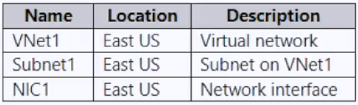 You create a route table named RT1 in the East US Azure region.
To which resources can you associate RT1?
You create a route table named RT1 in the East US Azure region.
To which resources can you associate RT1?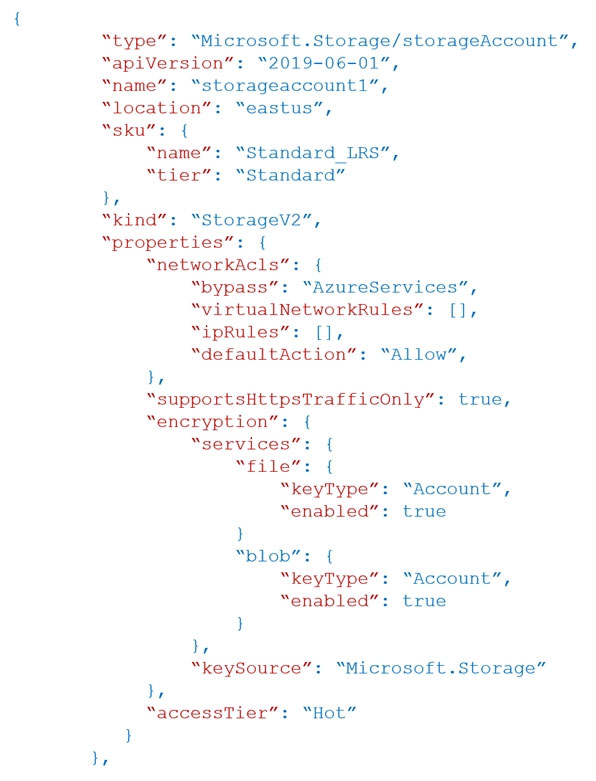 For each of the following statements, select Yes if the statement is true. Otherwise, select
No. Hot Area:
For each of the following statements, select Yes if the statement is true. Otherwise, select
No. Hot Area:
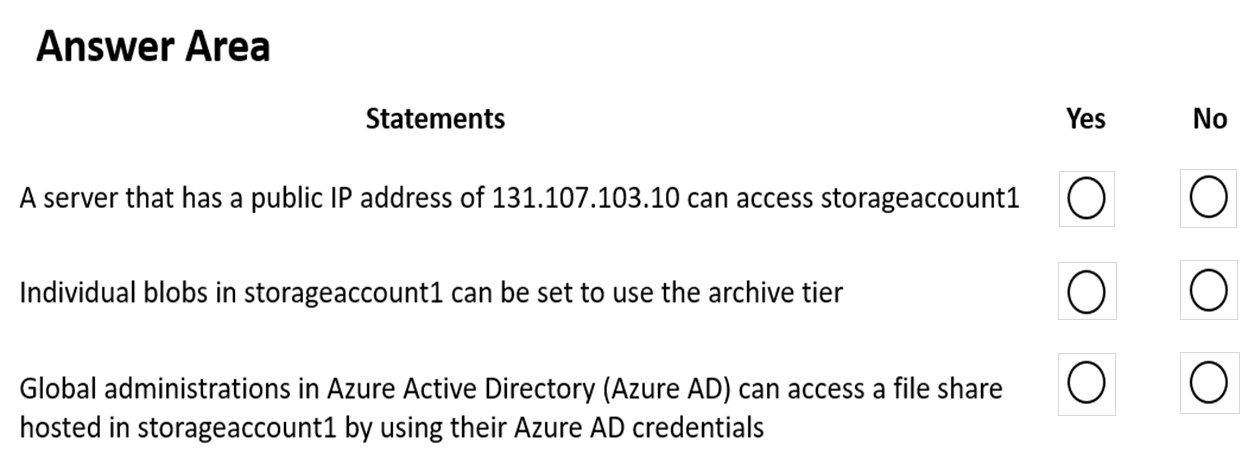
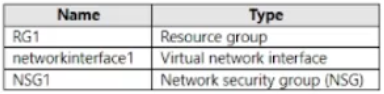 NSG1 is associated to networkinterface1. User1 has role assignments for NSG1 as shown
in the following table.
NSG1 is associated to networkinterface1. User1 has role assignments for NSG1 as shown
in the following table.
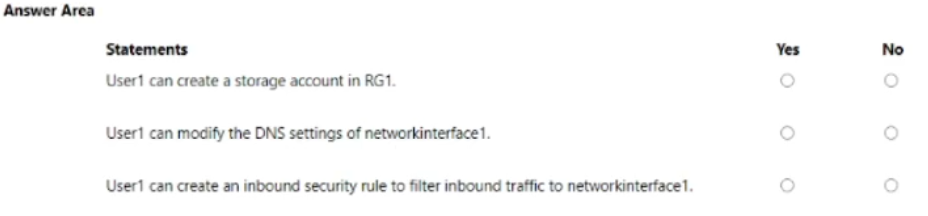
 For each of the following statements, select Yes if the statement is true. Otherwise, select
No.
For each of the following statements, select Yes if the statement is true. Otherwise, select
No.
 You need to delete TestRG. What should you do first?
 For the Instance limits scale condition setting, you set Maximum to 5.
During a 30-minute period, App1 uses 80 percent of the available memory.
What is the maximum number of instances for App1 during the 30-minute period?
For the Instance limits scale condition setting, you set Maximum to 5.
During a 30-minute period, App1 uses 80 percent of the available memory.
What is the maximum number of instances for App1 during the 30-minute period?