
DRAG DROP Match the facial recognition tasks to the appropriate questions. To answer, drag the appropriate task from the column on the left to its question on the right. Each task may be used once, more than once, or not at all. NOTE: Each correct selection is worth one point. 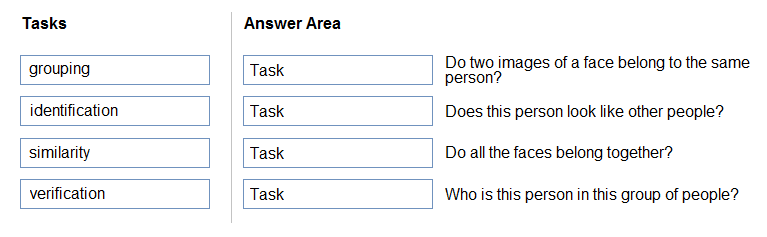
I'm pretty sure that's right since grouping is clustering (trap is confusing similarity and grouping), but if anyone thinks otherwise let me know.
Seen similar in some practice sets and official docs. It's: verification → Do two images of a face belong to the same person, similarity → Does this person look like other people, grouping → Do all faces belong together, identification → Who is this person in this group. If you're reviewing, check official guide for these terms.
Pretty straightforward if you’ve seen these terms before. "Do two images of a face belong to the same person?" is verification, since it’s checking 1:1. "Does this person look like other people?" maps to similarity. Grouping is clustering unknowns, so that fits with "Do all the faces belong together?". Finally, "Who is this person in this group of people?" is classic identification. I’m fairly sure these are what MS expects here, but open to correction if I missed anything!
- Do two images of a face belong to the same person? → verification
- Does this person look like other people? → similarity
- Do all the faces belong together? → grouping
- Who is this person in this group of people? → identification
