
HOTSPOT Select the answer that correctly completes the sentence 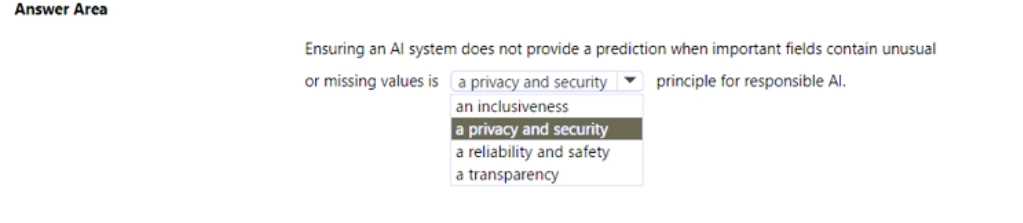
Looks like reliability and safety is the better match here. Privacy/security feels tempting, but for missing or weird data fields these questions usually want the system to avoid unsafe predictions, so safety comes first I think. Anyone see it differently?
Reliability and safety fits best. Privacy/security is tempting but in scenarios with missing or weird data, the exam usually tests for reliability first. I think some might mix it up with privacy, but not here.
Reliability and safety fits best here since the system refuses to predict when inputs are sketchy or incomplete. That prevents bad or harmful results, which is kind of the whole point of that principle. Transparency is important too but doesn't quite cover this specific "fail-safe" behavior, I think. Open to other views though.
