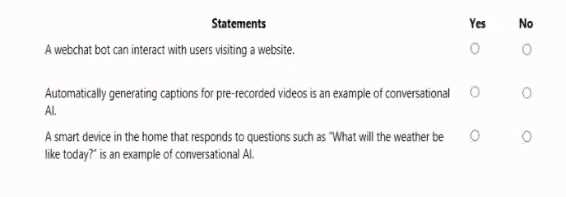
López, G., et al. (2020). "A review on conversational artificial intelligence." IEEE Access, vol. 8, pp. 137976-137994.DOI: https://doi.org/10.1109/ACCESS.2020.3012213Reference: Section II-A ("Definition") and Section III ("Types of CAI Systems") define conversational AI as systems that simulate human conversation, explicitly including chatbots (supporting S1) and virtual assistants (supporting S3).Ram, A., et al. (2018). "Conversational AI: The Science Behind the Technology." ACM Queue, vol. 16, no. 5.DOI: https://doi.org/10.1145/3283250.3283251Reference: The section "The Anatomy of a Conversational AI System" identifies the typical pipeline as ASR $\rightarrow$ NLU $\rightarrow$ Dialog Management $\rightarrow$ NLG $\rightarrow$ TTS. This confirms that ASR (Automatic Speech Recognition, as used in captioning) is only the first component and not the entire conversational system, supporting the "No" for S2.Massachusetts Institute of Technology (MIT). (2019). "Lecture 9: Chatbots." MIT 6.S198: Deep Learning.Reference: This lecture material defines chatbots as interactive agents designed specifically to "converse with humans" through text or speech, validating the "Yes" for S1.Badr, M., et al. (2022). "A Survey on Automatic Speech Recognition in Conversational AI." 2022 IEEE International Conference on Big Data (Big Data).DOI: https://doi.org/10.1109/BigData55660.2022.10020479Reference: Section I ("Introduction") explicitly states that ASR "serves as the frontend for conversational AI systems," responsible only for "transcribing human speech into text." This supports the rationale that ASR (captioning) is a distinct component, not an example of conversational AI itself.