1. Nokia 7750 SR OS Services Guide, Release 21.10.R1, Section: BGP-MVPN for VPLS.
Reference: "The PE routers run an instance of PIM or IGMP snooping that learns of C-multicast streams and receivers that are active in the VPLS. This information is then advertised by BGP to all other PE routers that are part of the same VPLS service."
Comment: This official documentation distinguishes between the learning of customer multicast state (via PIM/IGMP) and the advertisement of that state between PEs (via BGP), supporting the reasoning that BGP is not the originating signaling protocol.
2. RFC 6514: BGP Encodings and Procedures for Multicast in MPLS/BGP IP VPNs, Section 5: C-Multicast Routing.
Reference: "When a PE router that is attached to a particular VPN site learns, via a C-PIM instance, of a multicast source that is active within that site, it may originate a BGP update containing a C-multicast route."
Comment: This IETF standard, which defines BGP-MVPN, clarifies that the PE router learns of customer multicast activity via a Customer-PIM (C-PIM) instance and then originates a BGP update. This confirms that PIM is the customer-facing signaling protocol, while BGP is used for inter-PE communication.

 According to the display in the exhibit, which of the following is FALSE?
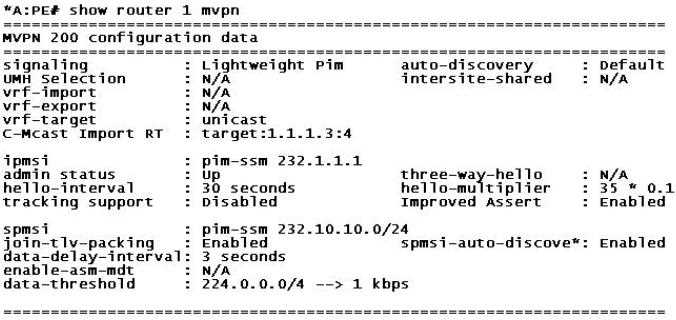 According to the display in the exhibit, which of the following is FALSE?