
Q: 11
A network architect must redesign a data center network based on OSPFv2. The network must perform fast
reconvergence between directly connected switches. Which two actions must be taken to meet the requirements?
(Choose two.)
Options
Discussion
C and E tbh. BFD (C) is what Cisco wants for fast, subsecond detection, and OSPF point-to-point (E) reduces convergence time since the topology's simpler. Pretty confident but open to other takes.
Option C and E make sense here. BFD is known for fast failure detection, and point-to-point links speed up OSPF convergence. Not totally certain, but saw similar on practice exams. Agree?
Would labbing this with BFD and point-to-point configs help clarify? I’ve seen similar reconvergence Qs pop up in official Cisco practice exams lately.
Had something like this in a mock and picked C and E. BFD (C) is used for subsecond failure detection with OSPF, while point-to-point links (E) simplify the topology, both speeding up convergence. If anyone disagrees let me know, but pretty sure that's Cisco's expected answer.
C vs B but I’m picking C and E here. B is tempting since lowering hello/dead timers does help, but Cisco exam style favors BFD (C) for subsecond detection and E’s point-to-point links cut down on convergence complexity. Don’t think A or D get you any faster reconvergence directly.
Its C and E. BFD (C) is designed for rapid failure detection, much quicker than OSPF timers alone, and point-to-point links (E) let OSPF converge faster because there’s less ambiguity in the topology. Low hello/dead timers (B) help too, but BFD’s even faster and less intensive on resources. I think C/E aligns best with how Cisco wants you to answer this.
C and E tbh. BFD gives you really quick failure detection with OSPF and point-to-point links help with faster convergence too. I’ve seen similar in practice exams, so pretty sure this is right.
Be respectful. No spam.
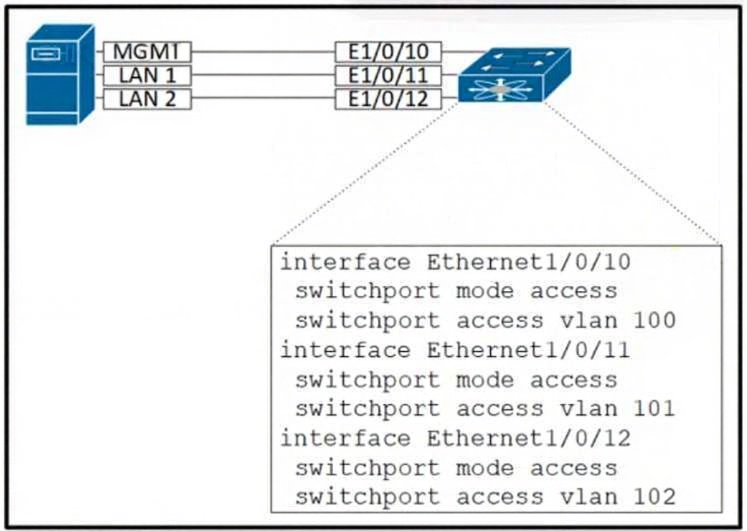 . Refer to the exhibit An engineer must access a Cisco UCS C-Series server KVM from a remote location. The engineer must use the out-of-band interface to access the KVM Which configuration set meets these requirements?
 Refer to the exhibit. Drag and drop the code snippets from the bottom onto the blanks in the code to complete the JSON request that implements the ACL presented. Not all code snippets are used. P-50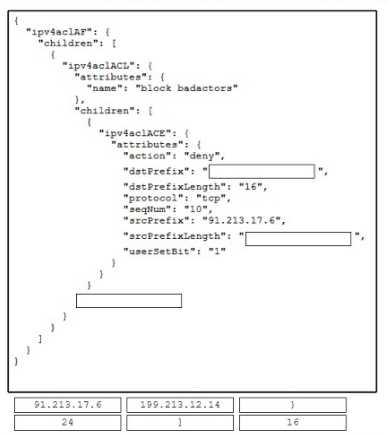
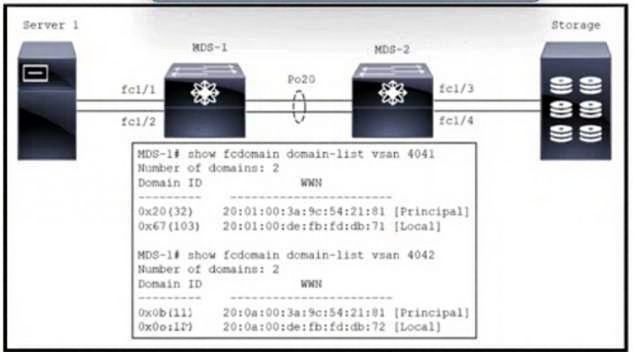 Refer to the exhibit The VSAN 4041 and 4042 are exchanged between two Cisco MDS 9000 Series Switches called MDS-1 and MDS-2 The objective is to deploy a security mechanism on MDS-1 to allow MDS-2 to join the fabric exclusively Drag and drop the code snippets from the bottom onto the boxes in the code to complete the MDS-1 configuration Not all code snippets are used.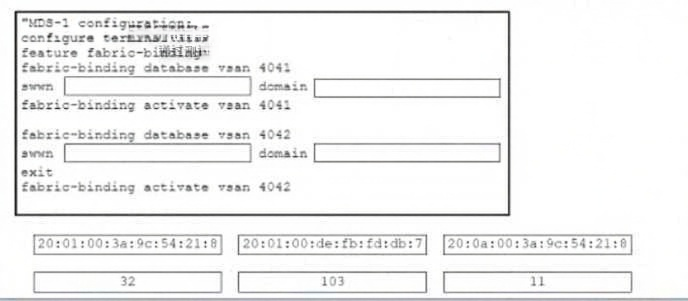
 B)
P-9
B)
P-9
 C)
C)
 D)
D)

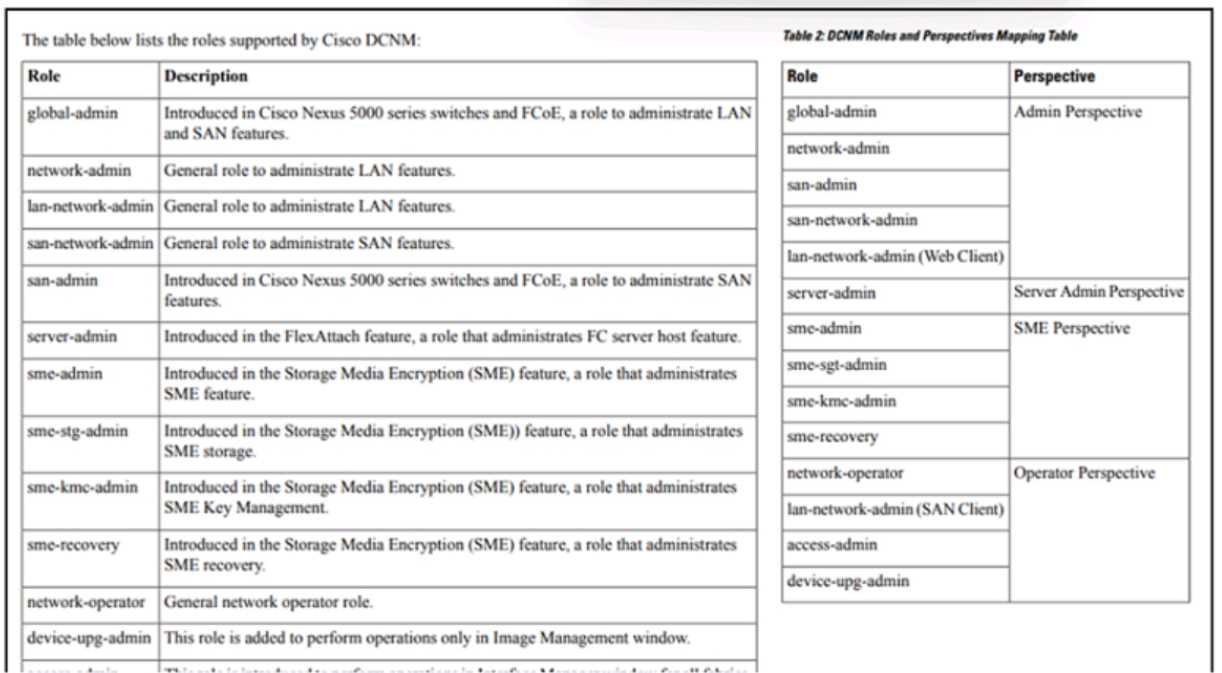 Refer to the exhibit. An engineer is configuring Cisco Data Center Network Manager to automate the provisioning of
Cisco Nexus 9000 Series Switches. The engineer must configure user access for network engineers to permit device
operations in Interface Manager. The solution must hide Admin and Config Menu items in Interface Manager Which
two roles must be assigned to the network engineers to meet these requirements? (Choose two.)
Refer to the exhibit. An engineer is configuring Cisco Data Center Network Manager to automate the provisioning of
Cisco Nexus 9000 Series Switches. The engineer must configure user access for network engineers to permit device
operations in Interface Manager. The solution must hide Admin and Config Menu items in Interface Manager Which
two roles must be assigned to the network engineers to meet these requirements? (Choose two.)