
Q: 9
Refer to exhibit.
P-37
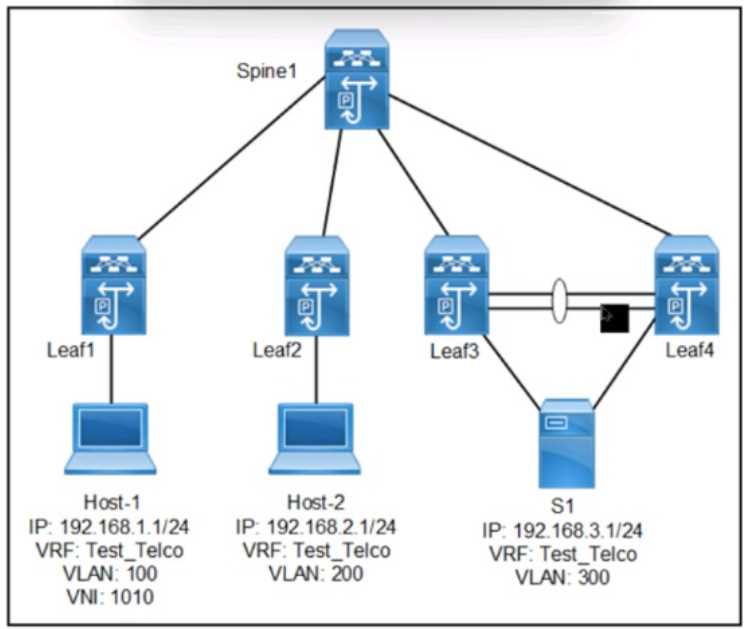 Refer to the exhibit A VXLAN data center fabric has three hosts mapped to three different VLANs. Ingress and egress
VTEPs perform Layer 2 and Layer 3 lookups VLAN 100 is mapped to VNI 1010 on Lead. Which set of actions allow
communication between Host-1 and Host-2?
Refer to the exhibit A VXLAN data center fabric has three hosts mapped to three different VLANs. Ingress and egress
VTEPs perform Layer 2 and Layer 3 lookups VLAN 100 is mapped to VNI 1010 on Lead. Which set of actions allow
communication between Host-1 and Host-2?
Refer to the exhibit A VXLAN data center fabric has three hosts mapped to three different VLANs. Ingress and egress
VTEPs perform Layer 2 and Layer 3 lookups VLAN 100 is mapped to VNI 1010 on Lead. Which set of actions allow
communication between Host-1 and Host-2?Options
Discussion
Definitely going with A. Mapping VLAN 200 to VNI 2020 on Leaf2 is what makes Host-2 reachable, seen it in lab configs too. Not 100 percent sure but this looks right, correct me if you think otherwise!
Option A. I don’t think B is right here, mapping VLAN 200 on Leaf2 is key and that’s in A (suppressing ARP alone is a common trap).
C or D? I see why A is tempting but if Layer 3 gets involved, enabling prefix-based routing (C) can sometimes change traffic flow. Maybe I'm thinking too much about routed scenarios but C seems plausible for VXLAN fabrics.
B or C? Mapping VLAN 200 is key but if they're asking specifically about L2 versus L3 behavior, enabling prefix-based routing (C) might change things. Curious if anyone hit an edge case with ARP suppression in a similar setup.
I don’t think D solves it, since that’s more about L3 VRF config. The real trick is making sure Host-2 can join the VXLAN fabric, so mapping VLAN 200 to a VNI on Leaf2 (A) matters most. Easy to miss if you just focus on VRF or ARP tricks, seen similar as a common trap in practice sets. Pretty sure A but let me know if I’m missing nuance.
Nah, I don’t think D works here. D’s more about L3, but to get Host-2 talking you actually need VLAN 200 mapped to a VNI on Leaf2 (so A). Trap is thinking attaching the VRF alone handles everything. Seen similar in practice exams-mapping first is key.
How do you get communication without mapping VLAN 200 to a VNI on Leaf2 first? Doesn't D miss the basic overlay setup?
I was thinking B might be right since ARP suppression plus anycast gateway can help with host reachability. VXLAN fabrics often use those for efficiency even if it’s not always needed. Maybe I’m missing something?
Looks like A is right. Mapping VLAN 200 to a VNI on Leaf2 brings Host-2 into the VXLAN segment, so they can talk at L2. The other options add extra features but don't actually solve the base connectivity issue. Correct me if I'm missing something.
B , since ARP suppression and anycast gateway can both help with host reachability in VXLAN fabrics. Just feels like you'd want to reduce broadcast traffic for efficiency. Not totally sure here, maybe I missed something.
Be respectful. No spam.
