
Q: 1
How much must the MTU be increased when configuring the 802.1q VLAN tag?
Options
Discussion
Option B, Similar question popped up on practice exams, always 4 bytes for 802.1q tag.
B . It's 4 bytes for the 802.1q VLAN tag, official Cisco docs and lab sims always show that value. If you want to see it hands-on, try packet captures in a lab environment. Correct me if I'm missing something.
Maybe A. I remember some L2 headers are just a couple bytes, so 2 seemed right for VLAN tags. Not totally sure since there's some confusion between different tagging methods here, but that's how I used to think about it. Anyone see actual exam phrasing favoring this?
B vs D. Saw similar wording on another mock, and it's easy to mix up with QinQ/double tagging (which would be higher). Here, since it's just single 802.1q tag, I'm pretty sure they're after B, not D, but happy to hear arguments for D if anyone thinks otherwise.
Option B makes sense because the standard 802.1q tag adds exactly 4 bytes to the frame. I think sometimes people confuse it with other tagging mechanisms or scenarios like QinQ, but for single VLAN tagging it's just 4. If they've worded it to imply classic 802.1q, B is right. Anyone feel differently?
Wouldn’t the answer change if jumbo frames were already in use or if double tagging (QinQ) was specified? Standard is B for 802.1q, but extra tags or non-standard MTUs could flip it. Anyone else notice that edge case?
A is wrong, B, . Official Cisco guide or hands-on labs both cover this type of MTU question pretty well.
B tbh, single 802.1q tag is 4 bytes, D's a distractor if you're thinking QinQ.
Nah, not D-easy trap since double-tag (QinQ) would need more. For normal 802.1q it's B.
Would official Cisco docs or lab sims be best to check this MTU detail for 802.1q tags?
Be respectful. No spam.
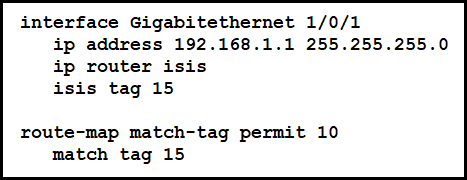 Refer to the exhibit. A large organization is merging the network assets of a recently acquired competitor with one of its own satellite offices in the same geographic are a. The newly acquired network is running different routing protocol than the company's primary network. As part of the merger a network engineer implemented this route map Which task must the engineer perform to complete the Implementation?
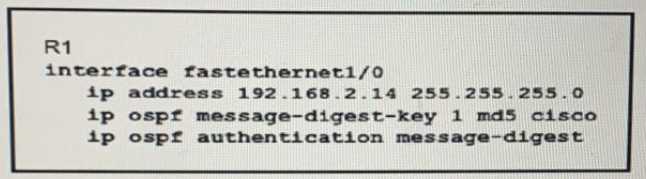 Which condition must be met by the OSPF peer of router R1 before the two devices can establish communication?
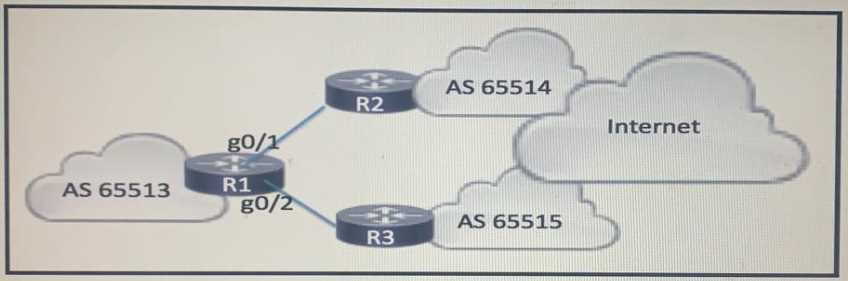 R1 is connected to two service providers and is under a DDoS attack Which statement about this design is true if uRPF in strict mode is configured on both interfaces'?
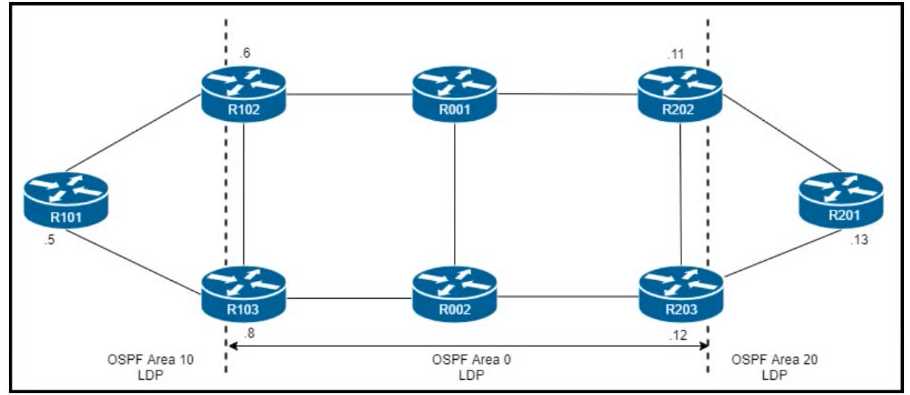 R101 is peering with R102 and R103, and R201 is peering with R202 and R203 using iBGP Labeled Unicast address families. The OSPF area 0 border routers are in a full iBGP Labeled Unicast mesh, and VPNv4 routes are exchanged directly between PE routers R101 and R201 through iBGP Which address family-level configuration must be applied on ABR R102 on ABR R102 to support a Unified MPLS routing architecture with partitioned IGP domains? A)
  B)
B) 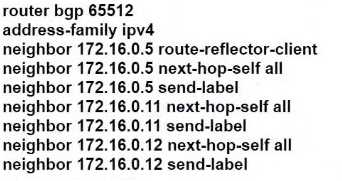 C)
C) 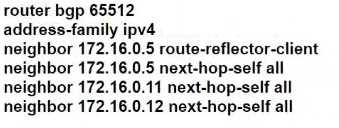 D)
D) 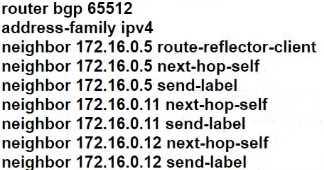
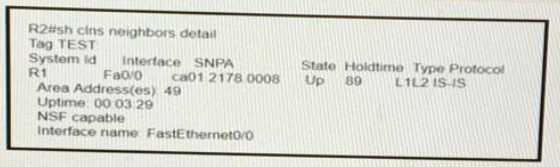 On R1, which output does the show isis neighbors command generate? A)
  B)
B)  C)
C)  D)
D) 
