
Q: 16
DRAG DROP Drag and drop the NAT64 descriptions from the left onto the correct NAT64 types on the right. 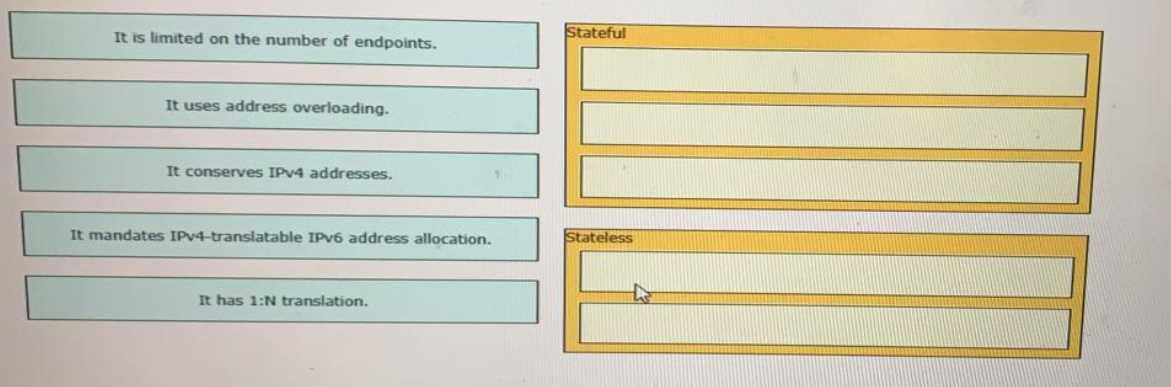
Drag & Drop
Discussion
Pretty sure this mapping holds up, but worth noting: Stateless NAT64 needs explicit IPv4-translatable IPv6 addresses, so no address overloading there. Stateful NAT64 does the traditional overloading/conservation trick with 1:N translation. Seen a similar question on some practice sets.
This matches what I've seen in the Cisco docs: stateful uses address overloading with 1:N translation to save IPv4, while stateless can't overload and is limited by needing IPv4-translatable IPv6. Probably the right mapping but someone shout if they see otherwise.
Stateful: 1:N translation, address overloading, IPv4 conservation. Stateless: endpoint limit, needs translatable IPv6. That's what I've seen in the docs and lab tasks too. Pretty sure this is the right split but open to double-checking.
Stateful: 1:N translation, address overloading, IPv4 conservation. Stateless: endpoint limit, requires translatable IPv6. Think answer B trips folks up.
Be respectful. No spam.
