Cisco Webex Developer Documentation: The structure of the LstRecording response is officially documented. The XML response body contains a element, which in turn holds one or more elements. When converted to a JavaScript object, this hierarchy is preserved, validating the access path bodyContent.recording.
Source: Webex Meetings XML API Reference Guide, LstRecordingResponse section. (Specific URL varies by documentation version, but the structure is consistent).
Mozilla Developer Network (MDN) Web Docs: This is an authoritative resource for JavaScript fundamentals. The documentation on property accessors explains how to use dot notation (.) to access properties of an object and bracket notation ([]) to access array elements by their index. This validates the syntax recordings[i].streamURL.
Source: MDN Web Docs, "Property accessors". https://developer.mozilla.org/en-US/docs/Web/JavaScript/Reference/Operators/Property_accessors
xml2js Library Documentation: The official documentation for the xml2js library explains that XML tags are converted into keys on the resulting JavaScript object. Namespace prefixes (like serv: and ep:) are typically stripped by default, which is why the code uses message and recording directly.
Source: npm package documentation for xml2js. https://www.npmjs.com/package/xml2js#options

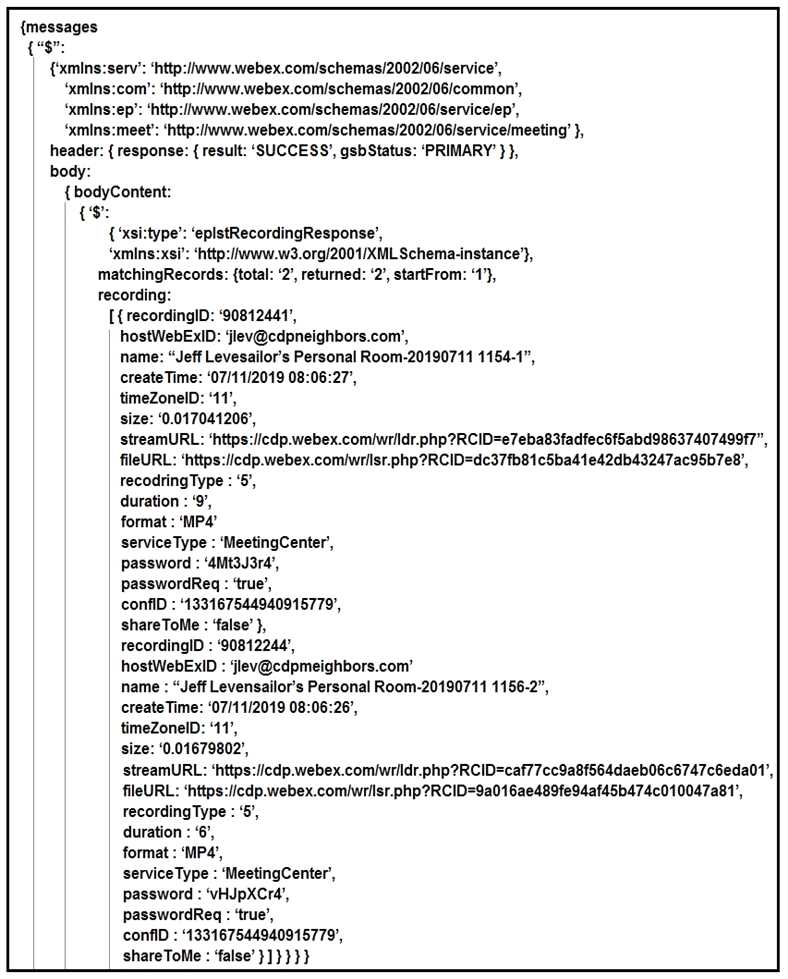 A training coordinator must post links to Webex recordings on a company SharePoint site. This is usually a manual process, but a DevOps engineer wants to automate it using Webex XML APIs. After a sucessful LstRecording call wrapped in xml2js, the ‘console dir(result)’ output is shown in the exhibit. Using ‘dot notation’, drag and drop the code below onto the code snippet to output the streamURL for each recording.
