
Q: 9
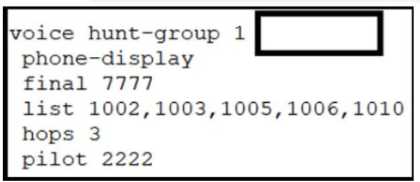
Refer to the exhibit.
 DN 1003 was the last to ring during the most recent call. Which hunting method ensures that DN
1005 is presented with the next call when the hunt pilot is dialed?
DN 1003 was the last to ring during the most recent call. Which hunting method ensures that DN
1005 is presented with the next call when the hunt pilot is dialed?
 DN 1003 was the last to ring during the most recent call. Which hunting method ensures that DN
1005 is presented with the next call when the hunt pilot is dialed?
DN 1003 was the last to ring during the most recent call. Which hunting method ensures that DN
1005 is presented with the next call when the hunt pilot is dialed?Options
Discussion
Yeah, it's D here. Peer hunting picks up with the next DN after the last one that rang, so if 1003 was last, 1005 is next in line. Pretty sure that's what the feature does.
D , because peer hunting picks up where the last call ended and gives it to the next DN, so it doesn't always start at the top. Sequential (C) would just keep starting at 1001. Anyone disagree?
Its D, peer is the one that hands off the next call to the DN after the last to ring, not sequential.
C vs D? Sequential is tempting, but peer hunting is the only one that hands off to the next DN after the last one rang. Pretty sure it's D unless I missed something about the reset.
C tbh
C/D? Practice tests and Cisco doc explain peer vs sequential a bit differently, not fully sure based just on this.
C vs D. I picked C (sequential) because it sounds like each new call should move to the next DN in order, but now I'm second-guessing if peer (D) does something similar. In some hunt configs, sequential always starts at the top, so maybe I'm overthinking it. Anyone else tripped up by this?
If the last call went to 1003 and you want 1005 to get the next one, doesn't that basically describe peer hunting (D)? Sequential would start over at the first DN again. Pretty sure that's how Cisco hunt groups work but chime in if you see it differently.
D
D , peer hunting moves the next call to the DN right after the last one that rang, so 1005 gets it if 1003 was last. Sequential (C) is a trap since it restarts from the top every time. If anyone thinks otherwise, let me know.
Be respectful. No spam.
