
Q: 4
Refer to the exhibit.
 A user cannot call number 730. which Is an abbreviated number for 45730. The engineer recently
configured a translation pattern In Cisco UCM. The newly configured translation pattern of 7XX
prefixes the digits 45. The engineer uses DNA to troubleshoot the issue. What is the reason for this
problem?
A user cannot call number 730. which Is an abbreviated number for 45730. The engineer recently
configured a translation pattern In Cisco UCM. The newly configured translation pattern of 7XX
prefixes the digits 45. The engineer uses DNA to troubleshoot the issue. What is the reason for this
problem?
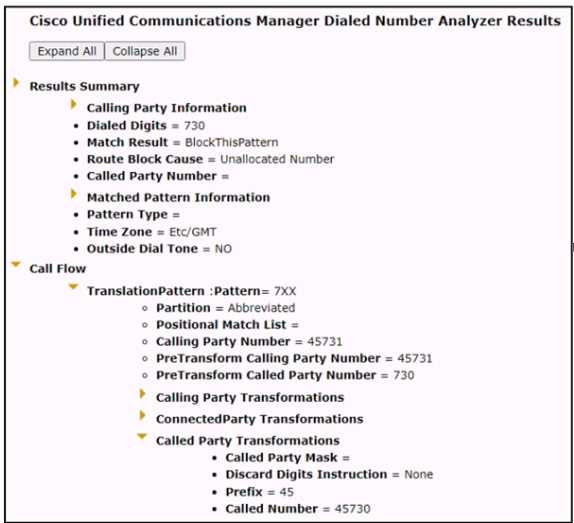 A user cannot call number 730. which Is an abbreviated number for 45730. The engineer recently
configured a translation pattern In Cisco UCM. The newly configured translation pattern of 7XX
prefixes the digits 45. The engineer uses DNA to troubleshoot the issue. What is the reason for this
problem?
A user cannot call number 730. which Is an abbreviated number for 45730. The engineer recently
configured a translation pattern In Cisco UCM. The newly configured translation pattern of 7XX
prefixes the digits 45. The engineer uses DNA to troubleshoot the issue. What is the reason for this
problem?Options
Discussion
A . DNA wouldn't show any match if the partition isn't in the CSS, so translation pattern never even gets hit. C is tricky but that's not what's blocking it here from what I remember on similar practice questions.
Why not C here? If the translation pattern is off, 730 won't convert to 45730 either way.
A imo, the trap is C but if the partition for abbreviated dialing isn't in the CSS, translation won't get triggered at all. UCM just can't match the 730. Pretty sure that's it but open to corrections.
Looks like the partition for abbreviated dialing isn't in the CSS, so A.
C/D? Not totally sure but both could cause issues. Anyone else think it's not just the partition?
B
I think C here. If the translation pattern isn't set right, 730 won't expand to 45730 at all.
Maybe A. If the partition isn't in the CSS, DNA can't match anything before it even hits translation.
I don't think it's C. If the partition for abbreviated dialing isn't in the calling search space, dialing 730 just won't match anything, so translation pattern doesn't even trigger. Happened to me once on a config lab-think A makes sense here, but feel free to disagree.
A, not C. If the abbreviated partition isn’t in the CSS, dialed digits never even hit the translation pattern. C is tempting but wrong here since DNA shows no match if partition access is missing. Pretty sure that’s what’s happening.
Be respectful. No spam.
