View Mode
Q: 11
An organization deploys Cisco UCS-X Series servers in the data center. The deployment must have optimal BIOS configuration to maximize performance for memory-intensive applications. The organization must set the BIOS options to achieve low-latency operation and enhanced memory bandwidth. Which BIOS tuning option on Cisco UCS-X Series servers is needed for memory-intensive workloads?
Options
Q: 12
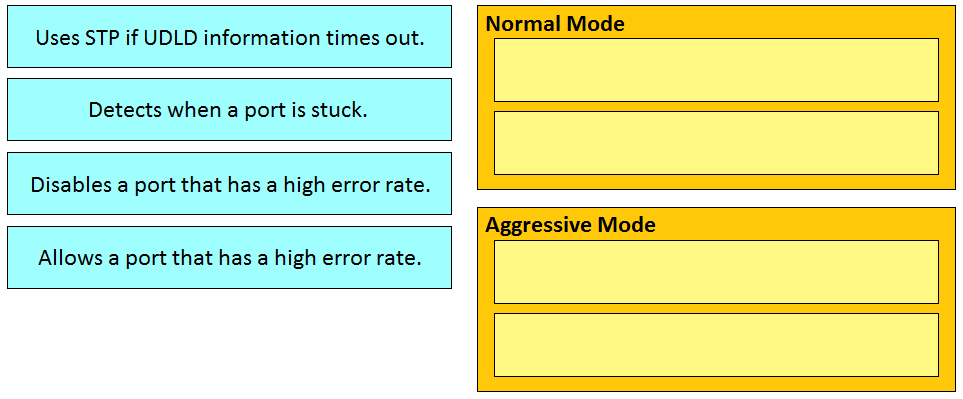
DRAG DROP Drag the appropriate from the left onto the current UDLD modes of operation on the right. 300-610 question
Your Answer
Q: 13
A Cisco engineer is analyzing a customer environment where dozens of VMs are running on a physical server and UCS chassis are cascaded The setup uses two ISLs in a port channel to the SAN switch (per fabric) The oversubscription from VM to physical SAN port is often 20 (VMs/host) x 72 (9 UCS chassis cascaded = 72 hosts): 2 (ISLs from fabric interconnect to SAN switch port on the NPV core (NPIV enabled switch) This results to 20 x 72 2 per single ISL = 720 VMs per ISL 20 (VMs per host) x 8 (hosts per chassis) x 9 (chassis per port channel to SAN switch) / 2 (ISLs per port channel) = 20 x 8 x 9 / 2 = 720 VMs per SAN F-port What is the best way to resolve possible IOPS bottleneck?
Options
Q: 14
An engineer is installing a Cisco Nexus 7000 Series Switch with F2-Series I/O Module. The company's strict security policy requires that the port be in-band. The engineer must also keep these considerations in mind: The customer's security requirements mandate the use of a secure management mechanism that supports authentication and encryption. The port should support management over IP. Which port type must be used to meet these requirements?
Options
Q: 15
Refer to the exhibit During a synchronization of port rotes, a device receives a proposal message on one of its ports that is selected as the new root port. The logs show that Rapid PVST+forced all other ports to synchronize with the new loot information. The engineer analyzes the port stales and concludes that the device is synchronized with superior root information received on the root port, and all other ports are synchronized. What happens to a designated port that is in the forwarding state and is not configured as an edge port, if Rapid PVST+ forces it to synchronize with new root information?
Options
Q: 16
A network consultant evaluates the Cisco UCS Fabric Interconnect SAN configuration, which must meet these requirements: All traffic must pass over the upstream device for switching and domain IDs must be preserved in the fabric. Each server should be pinned to one designated upstream interface and for the traffic to pass through the pinned port. Which Fabric Interconnect SAN operational mode meets these requirements?
Options
Q: 17
A network architect is designing a storage network to connect to an existing IP network over 100G Ethernet ports for multiple hosts The architect decided to require iSCSI multipathmg to provide multiple routes between servers within the SAN and storage devices that reside within the IP network. Which requirement must be applied to the IP network switch that connects to the SAN environment where the hosts reside9
Options
Q: 18
An engineer is deploying a Fabric Interconnect within a data center SAN over a Fiber Channel link in end-host mode. The hosts are connected through multiple vHBAs, each of which has been hard- pinned to a specific Fibre Channel uplink. What happens to the vHBAs if the Fibre Channel uplink port fails?
Options
Q: 19

A network engineer is connecting a backup server to the given network The server has three available physical Ethernet interfaces - dual 1Gbps interfaces, plus a single 10Gbps interface - and all devices support virtual port channels The engineer must minimize backup time from hosts on the network, with a mandate for no single point of failure connectivity within the data center and the interfaces either active or passive Which deployment model must the engineer use? A)

B) C) D)

Your Answer
Q: 20
An engineer must design Layer 2 connectivity for a subnet between two data centers. The engineer must ensure seamless host mobility and optimal first-hop routing. Which attribute must be synchronized across all data centers to achieve this goal?
Options
Question 11 of 20 · Page 2 / 2

Premium Access Includes

  • Quiz Simulator
  • Exam Mode
  • Progress Tracking
  • Question Saving
  • Flash Cards
  • Drag & Drops
  • 3 Months Access
  • PDF Downloads
Get Premium Access
Scroll to Top

FLASH OFFER

Days
Hours
Minutes
Seconds

avail 10% DISCOUNT on YOUR PURCHASE