Q: 1
In which direction does the Cisco DNA Center Intent API communicate?
Options
Discussion
Option C since northbound APIs like this one expose controller functions to apps. Wouldn't pick southbound unless the API talked directly to devices, which it doesn't. Pretty sure that's how Cisco labels it, but open to debate.
C , matches what I've seen in official Cisco docs and practice tests. Northbound APIs like the DNA Center Intent API are for exposing functions to applications above the controller layer, not talking to network devices (that would be southbound). If you're prepping, check out some lab guides for hands-on with the API-really helps clear up these concepts. Pretty sure about this but if anyone has a counter example from another Cisco platform let me know.
Probably C, saw a similar question on a practice exam and northbound is always used for controller APIs like this.
C imo, pretty sure Intent APIs are northbound for app-to-controller. Not 100 percent, so someone correct me if I’m wrong.
Be respectful. No spam.
Q: 2
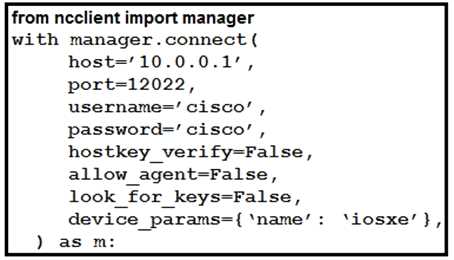
Refer to the exhibit.
What is the correct ncclient method to use to collect the running configuration of a Cisco IOS XE
device that uses NETCONF?
What is the correct ncclient method to use to collect the running configuration of a Cisco IOS XE
device that uses NETCONF?Options
Discussion
D. not A. Only
get_config is valid for pulling the running config using ncclient with NETCONF. A is used for copying configs, which doesn't match what they're asking here. Pretty sure about this but open to other takes.Ugh, Cisco could make this easier. Probably D-
get_config is the right ncclient method for dumping running config with NETCONF. The others don't match Python client syntax from what I've seen.Is the question asking for retrieving the config only, or also making changes after? Would that change A vs D?
Be respectful. No spam.
Q: 3
The Cisco DNA Center Sites API must be used to add a device to a site, but only the site name is
available. Which API call must be used to retrieve the site identifier so that the device can be
properly added to the network?
Options
Discussion
Yeah, it's C in this case.
I think C is right since the v1 endpoint returns all site info so you can map the name to the ID. Seen this on a few labs, pretty standard approach. Happy to be corrected but that's how I remember it.
C had something like this in a mock. The v1 API endpoint gives you the details for searching by site name and lets you grab the site ID. Not 100 percent but pretty sure that's right.
Probably C, that's the correct endpoint version for getting site details in DNA Center.
Be respectful. No spam.
Q: 4
Which two features are characteristics of software-defined networks when compared to traditional
infrastructure? (Choose two.)
Options
Discussion
I don't think it's E, that's a common trap. CD fits since SDNs use overlays and are designed for quick changes.
Maybe C and E. I get that overlays are a thing in SDN, and I thought managing SDN needed some coding? Not sure if that's exactly what they're after here, can anyone confirm?
C/D? Most SDN exam practice I’ve seen says overlays and being designed for changes are the key things, not manual config.
Definitely looks like C and D to me. Overlays are fundamental in SDN and it's meant to be flexible by design, unlike traditional networks that are more static. Pretty sure those are the two main differences compared here, unless I'm missing something.
C/D? Overlay networks are core to SDN and they’re built for flexibility, not manual config.
Be respectful. No spam.
Q: 5
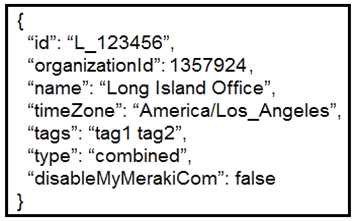
Refer to the exhibit.
Which two parameters are mandatory when the Cisco Meraki API is used to create a network?
(Choose two.)

Which two parameters are mandatory when the Cisco Meraki API is used to create a network?
(Choose two.)Options
Discussion
Its C and E. You need organizationId to specify which org the network belongs to, and type defines what kind of network it is (like appliance, wireless, etc). I’m pretty sure timezone isn’t a must for network creation via API. Let me know if anyone has seen different docs.
C and E, not A or D. You definitely need both organizationId and type according to Meraki API docs. Official guide and a quick check in their API explorer confirm this, so pretty confident here.
These Meraki API questions are worded so poorly! E, not D.
Is the question asking for the minimum required parameters or all that are commonly used? That would change if D could be right too.
Be respectful. No spam.
Q: 6
Fill in the blank to complete the statement.


Your Answer
Discussion
Option ZTP
C
Option PXE
Looks like PXE here. The question says "network boot", which makes me think of PXE since that's all about booting a system over the network, not really device provisioning like ZTP. I remember a similar trap on another practice test. Could be reading the intent wrong though, but pretty sure it's PXE unless they mean onboarding routers/switches.
Its PXE. The question is about network bootstrapping, so PXE came to mind rather than ZTP. Maybe I'm missing context, but I've seen similar on other exams.
Be respectful. No spam.
Q: 7
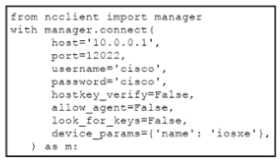
Refer to the exhibit.
Which ncclient method is used to collect the running configuration of a Cisco IOS XE device that uses
NETCONF?
Which ncclient method is used to collect the running configuration of a Cisco IOS XE device that uses
NETCONF?Options
Discussion
C or D? Leaning toward D since get_config() is what ncclient uses for grabbing configuration data specifically, like "running" config. C isn’t a real method though, right? Not 100 percent sure if anyone’s seen get() used for configs here.
D is the typical method here. In ncclient,
get_config() is meant to retrieve config data, specifically when you want something like the running config from IOS XE. get() is for general operational/state info, not just config. Pretty sure that’s the distinction Cisco expects. Open to being corrected if someone has seen a different real-world behavior.D
B not D. Saw similar syntax in some practice labs and the official guide, both showed m.get for getting config too.
Its D for this one, but it’s a bit tricky. Only
get_config() is the NETCONF operation specifically meant to pull config data (like running config) from IOS XE using ncclient. get() grabs operational/state data instead, not strictly config. So even though the others look close, only D fits exactly per NETCONF/RFC standards. Pretty sure, unless Cisco customized something.Option B makes sense to me since m.get seems like a straightforward way to retrieve data, and 'source=running' points to the running config. I haven’t seen get_config always required for this in some Python scripts. I think this is right, but if anyone knows why this wouldn't work over NETCONF, let me know?
Be respectful. No spam.
Q: 8
What are two characteristics of synchronous calls to APIs? (Choose two.)
Options
Discussion
C and D tbh, that's what you'd expect for blocking calls and possible latency.
CD tbh, matched what I saw on official practice and some API docs.
I don’t think it’s C and D. B seems right since async calls are often picked for portability reasons, so C and B make sense to me. Blocking is more about how it waits for response, which isn’t always just D.
Its C and B, seen a similar question in official practice. Check API labs too.
D imo, also C fits here. Both describe synchronous behavior since blocking and added latency are classic traits. Anyone see different options?
Option C and D, pretty sure based on similar questions from labs and official guide.
Be respectful. No spam.
Q: 9
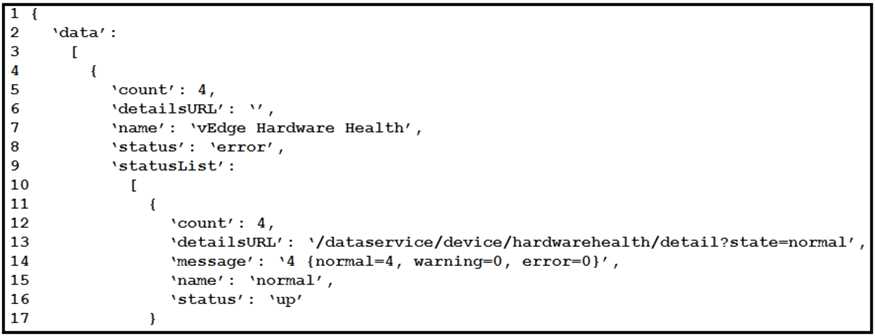
Refer to the exhibit.
Cisco SD-WAN deployment must be troubleshooted using vManage APIs. A call to vEdge Hardware
Health API returns the data in the exhibit (only a portion is shown). If this JSON is converted to a
Python dictionary and assigned to the variable “d”, how the status is accessed that is indicated on
line 16?
Cisco SD-WAN deployment must be troubleshooted using vManage APIs. A call to vEdge Hardware
Health API returns the data in the exhibit (only a portion is shown). If this JSON is converted to a
Python dictionary and assigned to the variable “d”, how the status is accessed that is indicated on
line 16?Options
Discussion
D. you need to use both string keys and integer indices when you have lists like this in nested JSON.
Makes sense from the JSON structure, you need to index into the lists using [0] and use string keys for the dictionaries. D is correct here, pretty sure that's also what shows up in similar practice questions.
Not seeing why B wouldn't work here. If both data and statusList are dicts, B looks right to me.
My vote is D. As long as data and statusList are both lists at those points, that should work. Not 100 percent sure though.
D, Saw this pattern in Cisco official labs, always use string keys for dicts and index with [0] for lists.
Be respectful. No spam.
Q: 10
What is a difference between OpenConfig and native YANG data models?
Options
Discussion
Native models are always vendor-specific, so A.
OpenConfig models are meant to be vendor-neutral, while native YANG is specific to each platform. That points to A since vendor-made native models are tied to their own hardware. Pretty sure A is correct unless there's a wording trick here, but open to debate.
Option D. I remember a similar scenario from labs and picked this one before.
Be respectful. No spam.
Question 1 of 20 · Page 1 / 2