
Q: 19
DRAG DROP
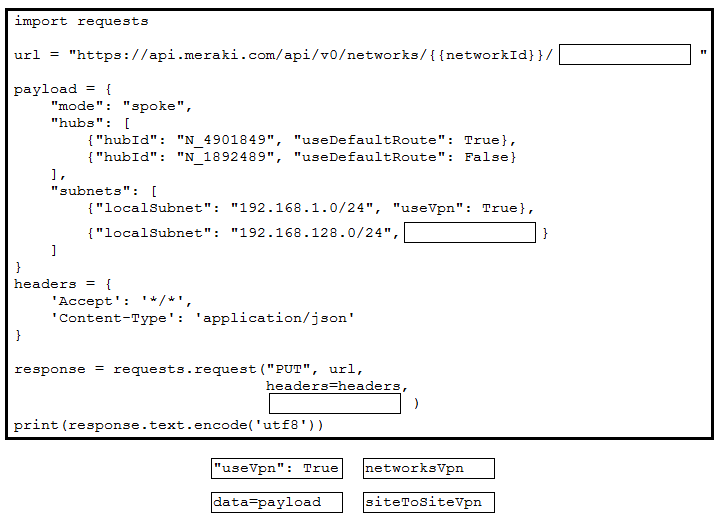
Drag and drop the code from the bottom onto the box where the code is missing to construct a
Python script to automate the process of updating the site-to-site VPN settings of the network. Not
all options are used.

Your Answer
Discussion
Pretty sure it’s C here. Meraki’s API uses PUT to update site-to-site VPN configs, not POST or GET. That fits with the reference link in the explanation. Anyone disagree?
Guessing B , I had something like this in a mock and it worked for VPN updates.
B
Similar question popped up in some practice sets, really straightforward drag and drop.
C, not B
Not B, C. Looks like Meraki requires PUT for updating VPN configs according to their API docs, not POST or GET.
C/D? B feels like a trap here, since POST usually won't update configs for Meraki VPN. I'm stuck between C and D, as the right endpoint and method combo matters. Anyone else?
C The Meraki API update for VPN configs uses PUT, not POST or GET.
C/D? I remember the Meraki API for VPN settings can be tricky, lots of folks pick B since it looks familiar but that’s usually for getting data not updating. Not 100% but C could be the trap here.
I don’t think it's B. C is correct for updating the VPN config since the Meraki API needs a PUT request, not POST or GET. That matches what’s in the docs and what worked for me in similar practice labs. Anyone see a reason to doubt C?
C or D? I feel like people jump right to B but if you check the Meraki API docs, updating VPN settings needs a
PUT to the right endpoint, not just a GET. Looks like the exam drags some folks with similar endpoints for reading vs updating configs. Pretty sure C is correct but open to someone pointing out if there's a catch.Be respectful. No spam.
