
An analyst is interested on comparing two audiences: men, ages 25-34 and men, ages 35-44. The brand wants to know if the older male customers spend more money on average than the younger male customers. The analyst collected random samples of 250 older customers and 220 younger customers and analyzed their shopping baskets. On average, younger men spend $102.23, and older men spend $86.46. Additional statistics are shown below. 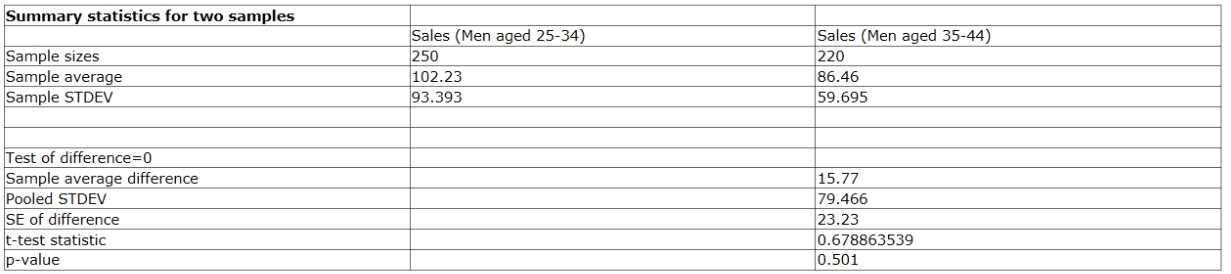 Which conclusion should the analyst make based on this data?
A here imo. Even though younger guys spent more on average, at a 90% confidence you need real statistical significance, not just a gap in means. Without enough evidence to pass that threshold, you can't say there's a difference. Pretty sure that's right but happy to see other takes.
Looks like A is the right one here. The sample averages are different, but at the 90% confidence level, you’d need a statistically significant difference to say anything for sure. Without a reported p-value under 0.10 or clear evidence, it’s safest to say there’s not enough proof. I think that’s what they want with A, but if anyone sees different stats in the image I missed, let me know!
Not D, the trap is thinking the mean difference proves significance. A.
A . I had something like this in a mock-since the average spend for younger men is higher, but with a 90% confidence level, unless the difference is statistically significant, you can't claim there's a real difference. The sample means alone aren’t enough without supporting stats (like p-value). Pretty sure that's what they're testing here. Open to corrections if I missed something in the stats!
