View Mode
Q: 1
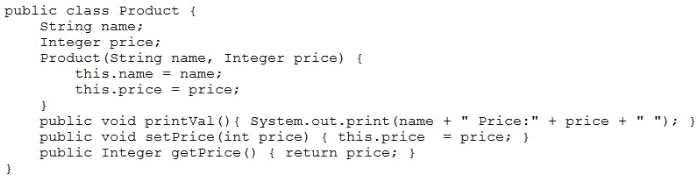
Given the code fragments : 1Z0-809 question and 1Z0-809 question What is the result?
Options
Q: 2
Given: public enum USCurrency { PENNY (1), NICKLE(5), DIME (10), QUARTER(25); private int value; public USCurrency(int value) { this.value = value; } public int getValue() {return value;} } public class Coin { public static void main (String[] args) { USCurrency usCoin =new USCurrency.DIME; System.out.println(usCoin.getValue()): } } Which two modifications enable the given code to compile? (Choose two.)
Options
Q: 3
Given: public class Product { int id; int price; public Product (int id, int price) { this.id = id; this.price = price; } Public String toString () { return id + “:” + price;) } and the code fragment: List products = new ArrayList (Arrays.asList(new Product(1, 10), new Product (2, 30), new Product (3, 20)); Product p = products.stream().reduce(new Product (4, 0), (p1, p2) -> { p1.price+=p2.price; return new Product (p1.id, p1.price);}); products.add(p); products.stream().parallel() .reduce((p1, p2) - > p1.price > p2.price ? p1 : p2) .ifPresent(System.out: :println); What is the result?
Options
Q: 4
Given the code fragment: List nL = Arrays.asList(“Jim”, “John”, “Jeff”); Function funVal = s -> “Hello : “.contact(s); nL.Stream() .map(funVal) .peek(System.out::print); What is the result?
Options
Q: 5
Given: 1. abstract class Shape { 2. Shape ( ) { System.out.println (“Shape”); } 3. protected void area ( ) { System.out.println (“Shape”); } 4. } 5. 6. class Square extends Shape { 7. int side; 8. Square int side { 9./* insert code here */ 10. this.side = side; 11. } 12. public void area ( ) { System.out.println (“Square”); } 13. } 14. class Rectangle extends Square { 15. int len, br; 16. Rectangle (int x, int y) { 17. /* insert code here */ 18. len = x, br = y; 19. } 20. void area ( ) { System.out.println (“Rectangle”); } 21. } Which two modifications enable the code to compile? (Choose two.)
Options
Q: 6

For which three objects must a vendor provide implementations in its JDBC driver? (Choose three.)

Options
Q: 7
Given the code fragment: List listVal = Arrays.asList(“Joe”, “Paul”, “Alice”, “Tom”); System.out.println ( // line n1 ); Which code fragment, when inserted at line n1, enables the code to print the count of string elements whose length is greater than three?
Options
Q: 8
Given: class CheckClass { public static int checkValue (String s1, String s2) { return s1 length() – s2.length(); } } and the code fragment: String[] strArray = new String [] {“Tiger”, “Rat”, “Cat”, “Lion”} //line n1 for (String s : strArray) { System.out.print (s + “ “); } Which code fragment should be inserted at line n1 to enable the code to print Rat Cat Lion Tiger?
Options
Q: 9
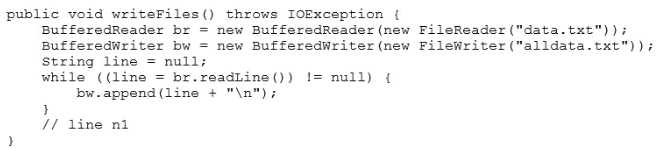
Given that data.txt and alldata.txt are accessible, and the code fragment: 1Z0-809 question What is required at line n1 to enable the code to overwrite alldata.txt with data.txt?
Options
Q: 10
Given: class Vehicle { int vno; String name; public Vehicle (int vno, String name) { this.vno = vno,; this.name = name; } public String toString () { return vno + “:” + name; } } and this code fragment: Set vehicles = new TreeSet (); vehicles.add(new Vehicle (10123, “Ford”)); vehicles.add(new Vehicle (10124, “BMW”)); System.out.println(vehicles); What is the result?
Options
Question 1 of 20 · Page 1 / 2

Premium Access Includes

  • Quiz Simulator
  • Exam Mode
  • Progress Tracking
  • Question Saving
  • Flash Cards
  • Drag & Drops
  • 3 Months Access
  • PDF Downloads
Get Premium Access
Scroll to Top

FLASH OFFER

Days
Hours
Minutes
Seconds

avail 10% DISCOUNT on YOUR PURCHASE