for the
complete solution.
Explanation:
Back-to-Back Supply Creation Flows in Oracle Cloud
Back-to-back (B2B) fulfillment in Oracle Fusion Cloud allows organizations to trigger supply creation
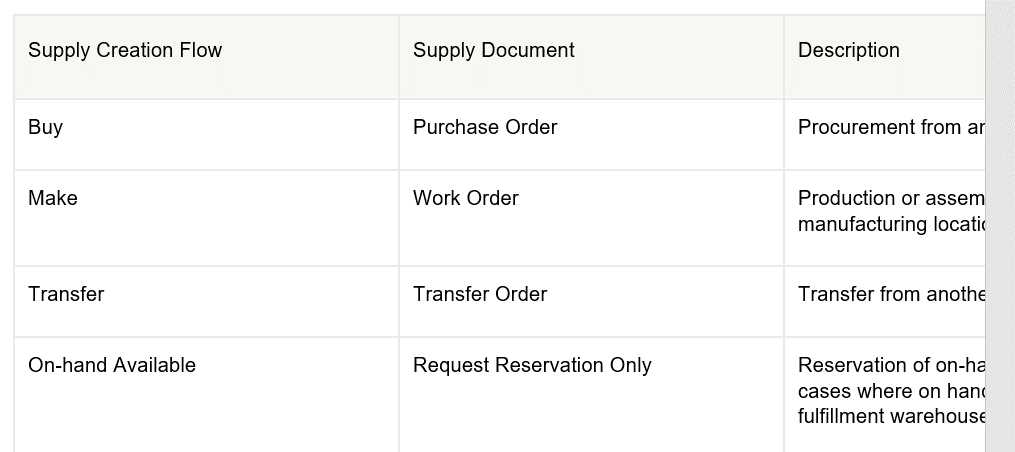
(Buy, Make, Transfer, or On-Hand Reservation) after a sales order is entered and scheduled. The
system dynamically generates supply documents depending on the source of the item and executes
supply fulfillment through Oracle Procurement, Manufacturing, or Inventory Management.
1. Overview of Back-to-Back Supply Creation Flows
Each back-to-back flow follows these key steps:
Sales Order Entry & Scheduling – A customer places an order that requires supply creation.
Supply Order Generation – The system determines the best supply source based on predefined
sourcing rules.
Supply Execution – The supply is created using procurement (Buy), manufacturing (Make), transfer
(Transfer), or existing stock (On-Hand).
Receiving & Reservation – The supply is received and linked to the sales order.
Order Fulfillment – The sales order is shipped to the customer.
2. Back-to-Back Supply Creation Buy Flow (Procurement-Based Fulfillment)
The Buy Flow is used when the required item is procured from an external supplier because it is not
available in stock or another warehouse.
Step-by-Step Buy Flow Process
Below is the step-by-step breakdown of the Back-to-Back Buy Flow with Oracle Fusion applications
involved:
Step 1: Initiate Back-to-Back Sales Order
The customer places a sales order in Oracle Order Management.
The system checks stock availability in Oracle Inventory Cloud.
If no stock is available, Oracle Supply Chain Orchestration (SCO) triggers a supply request.
Oracle Global Order Promising (GOP) determines procurement as the best supply source.
The sales order is scheduled for back-to-back fulfillment.
✅ System Action: The system marks the sales order for procurement and creates a supply order.
Step 2: Create Supply Order
Oracle Supply Chain Orchestration (SCO) generates a Supply Order.
The system determines that a Purchase Order (PO) is needed.
A Purchase Requisition is created in Oracle Procurement Cloud.
✅ System Action: The system sends a request for procurement.
Step 3: Request Purchase Order (PO)
Oracle Procurement Cloud converts the requisition into a Purchase Order (PO).
The PO is sent to the external supplier.
The PO is linked to the sales order, ensuring that supply is dedicated to fulfilling the order.
✅ System Action: The system creates a Purchase Order (PO) and tracks supplier delivery.
Step 4: Receive the Purchase Order (PO)
The supplier delivers the goods to the fulfillment warehouse.
The warehouse team receives the PO in Oracle Receiving.
The received inventory is updated in Oracle Inventory Cloud.
The supply is reserved against the back-to-back demand.
✅ System Action: The system marks the received supply as reserved for the sales order.
Step 5: Ship the Back-to-Back Sales Order
The order is picked, packed, and shipped from the warehouse.
Oracle Shipping Execution updates the order status.
An invoice is generated in Oracle Receivables.
The sales order is closed.
✅ Final Action: The system completes the order and ships it to the customer.
3. Oracle Fusion Cloud Applications Involved in Back-to-Back Buy Flow
https://kxbjsyuhceggsyvxdkof.supabase.co/storage/v1/object/public/file-images/1Z0-1073-25/page_57_img_1.jpg
4. Benefits of the Back-to-Back Buy Flow
✔ Reduces Inventory Holding Costs – No need to stock large quantities in advance.
✔ Ensures Order-Specific Procurement – Every sales order is directly linked to supply.
✔ Automates Procurement & Order Processing – Seamless integration between Oracle modules.
✔ Enhances Customer Satisfaction – Quick fulfillment by sourcing products efficiently.
✔ Optimizes Supplier Collaboration – Real-time PO creation and tracking with suppliers.
5. Real-World Use Case
Scenario: Electronics Distributor Fulfilling a Large Order
A distributor selling high-end laptops does not keep them in stock but procures them from suppliers
only when an order is placed.
Process Flow:
A corporate customer places an order for 50 laptops.
The system checks stock and finds no available inventory.
A Purchase Order is created in Oracle Procurement Cloud and sent to the supplier.
The supplier delivers the laptops to the warehouse.
The laptops are reserved against the sales order.
The laptops are shipped to the customer, and the invoice is generated.
✅ Result: The distributor minimizes inventory costs while fulfilling customer demand efficiently.

 Back-to-Back Supply Creation Buy Flow
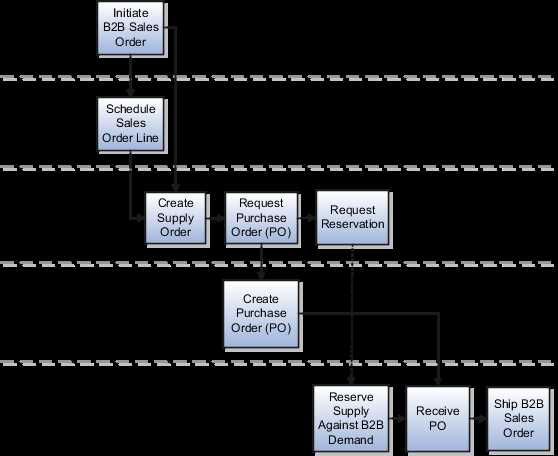
The supply document for a back-to-back buy flow is a purchase order. Based on supply
recommendations from Oracle Global Order Promising, a purchase order is created and reserved
against the sales order. When the purchase order is received by the supplier, on hand is created to
ship out the back-to-back sales order.
The following figure shows the back-to-back supply creation buy flow.
Back-to-Back Supply Creation Buy Flow
The supply document for a back-to-back buy flow is a purchase order. Based on supply
recommendations from Oracle Global Order Promising, a purchase order is created and reserved
against the sales order. When the purchase order is received by the supplier, on hand is created to
ship out the back-to-back sales order.
The following figure shows the back-to-back supply creation buy flow.
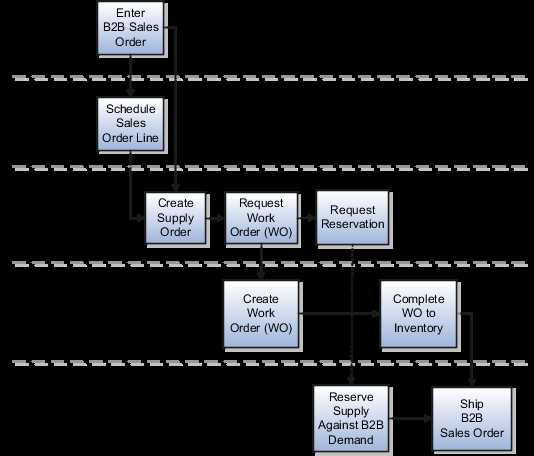 The supply document for a back-to-back make flow is a work order. As soon as the work order is
created in Oracle Fusion Cloud Manufacturing, it's tied to the back-to-back sales order in the form of
a reservation in inventory. The work order goes through the regular production process and the work
order completion transaction issues finished goods to inventory.
Note: Back-to-back flow is currently supported for only discrete manufacturing.
The following figure shows the back-to-back supply creation make flow.
Back-to-Back Supply Creation Transfer Flow
The supply document for a back-to-back make flow is a work order. As soon as the work order is
created in Oracle Fusion Cloud Manufacturing, it's tied to the back-to-back sales order in the form of
a reservation in inventory. The work order goes through the regular production process and the work
order completion transaction issues finished goods to inventory.
Note: Back-to-back flow is currently supported for only discrete manufacturing.
The following figure shows the back-to-back supply creation make flow.
Back-to-Back Supply Creation Transfer Flow
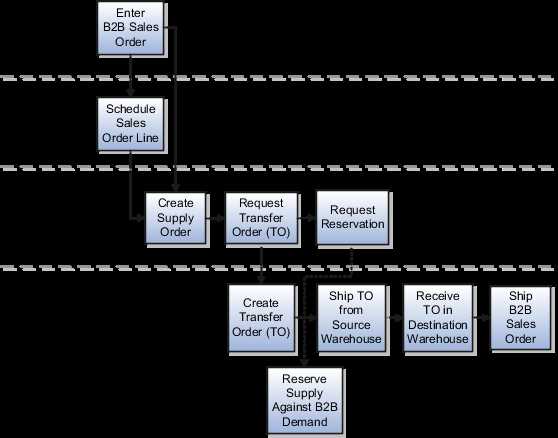 The supply document for a back-to-back transfer flow is a transfer order. The transfer order is created
in inventory and reserved against the back-to-back sales order. When the transfer order is ready to
be fulfilled, an interorganization shipment moves goods from the source organization to the
destination organization. An interorganization receipt in the destination organization (which is also
the fulfillment warehouse on the back-to-back sales order) creates on hand to fulfill the sales order.
The following figure shows the back-to-back supply creation transfer flow.
The supply document for a back-to-back transfer flow is a transfer order. The transfer order is created
in inventory and reserved against the back-to-back sales order. When the transfer order is ready to
be fulfilled, an interorganization shipment moves goods from the source organization to the
destination organization. An interorganization receipt in the destination organization (which is also
the fulfillment warehouse on the back-to-back sales order) creates on hand to fulfill the sales order.
The following figure shows the back-to-back supply creation transfer flow.