1Z0-822.pdf
Q: 1
Your company requires all nonglobal zones to have a limit on the number of processes. The policy is
designed to prevent runaway processes from impacting the global zone and other nonglobal zones.
To set a limit on processes, you set the following controls:
rctl:
name: zone.max-processes
value: (priv=privileged,limit=1000,action=none)
rctl:
name: zone.max-lwps
value: (priv=privileged,limit=5000,action=deny)
You must now enable system logging for the zone.max-processes resource control to record when
the limit is exceeded. Which command enables system logging for a resource control?
Options
Q: 2
You created a role. The role should be able to change the configuration of a zone. How will you assign
that privilege to the role?
Options
Q: 3
How many Network Configuration Units (NCUs) are required to configure a working Network
Configuration Profile (NCP)?
Options
Q: 4
You added an update to the system using a support repository updates (SRU) image:
# mkdir /SRU
# mount –F hsfs /var/tem/sru-name.iso /SRU
# pkgrecv –s /SRU/repo –d /export/IPS/repo ‘*’
You now want to clear all catalog, search and other cached information from this package repository.
Select the command that clears cached data.
Options
Q: 5
Laura is a user and netadm is a role on a Solaris 11 system. You want to allow Laura to generate SSH
keys. Which two steps should be taken?
Options
Q: 6
You need to configure three zones.
•
zone1 will run an HTTP server, zone2 an application server, and zone3 a database.
•
zone1 must be accessible to clients on other systems.
•
zone2 and zone3 must not be accessible to the outside world.
•
zone2 and zone3 must also communicate without going through zone1.
Identify the correct requirement.
Options
Q: 7
You administer an Oracle Solaris 11 system that uses a user-defined Network Configuration Profile
(NCP). You now need to modify the DNS name servers. Select the profile type that you will need to
modify.
Options
Q: 8
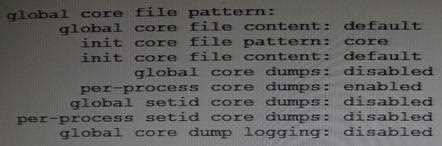
The following information describes the current dump configuration of your server:
Assume that the following command lines have been run on a system:
(root) # coreadm –g $HOME/var/core/%m.core.%f.%t
(non-root) $ coreadm –p core.%f.%p
Identify the result of a subsequent process crash.
Assume that the following command lines have been run on a system:
(root) # coreadm –g $HOME/var/core/%m.core.%f.%t
(non-root) $ coreadm –p core.%f.%p
Identify the result of a subsequent process crash.Options
Q: 9
You are configuring a system on your network that was installed using LiveCD. You configured applied
a static IP address to the system. You now need to configure a default router. Assume that name
services are file based and the router’s IP address is 172.31.10.1. Which two methods should you use
to configure a default route on this Oracle Solaris 11 system?
Options
Q: 10
You need to make a permanent modification to a machine's naming service. You need to change
naming service from files to LDAP. Which two alternative methods would accomplish this task?
Options
Question 1 of 10