Free SK0-005 Practice Test Questions and Answers (2026)

View Mode
Q: 1
Which of the following types of physical security controls would most likely be a target of a social engineering attack?
Options
29 comments in the community discussion
1
Honestly, CompTIA always does this by mixing tech and people in answers. It's A.
1
I see how D could work since attackers sometimes trick staff to override biometric locks, especially if there's poor policy or people get lazy about checking. D for that angle, since tech gets bypassed via humans now and then. Open to other takes though.
Q: 2
Which of the following policies would be BEST to deter a brute-force login attack?
Options
27 comments in the community discussion
3
D . Had something like this in a mock and account lockout threshold was flagged as the key control. It directly blocks repeated failed logins, which is exactly how brute-force works. Password complexity helps but doesn't actually stop the attempts.
1
Not convinced it's A. D actually prevents brute-force by locking the account, while complexity just makes guessing harder but doesn't block attempts.
Q: 3
An administrator needs to perform bare-metal maintenance on a server in a remote datacenter. Which of the following should the administrator use to access the server’s console?
Options
35 comments in the community discussion
1
I don’t think it’s A. Option D trips up a lot of people, I'd pick RDP for remote console tasks here.
1
Nah, it’s not B-VNC only works once the OS is running. For bare-metal (like BIOS or pre-boot) remote console, A (IP KVM) is what actually lets you interact before the OS loads. Got tripped by that a couple times in practice sets. Let me know if you think there’s a use case for anything but A.
Q: 4
A company deploys antivirus, anti-malware, and firewalls that can be assumed to be functioning properly. Which of the following is the MOST likely system vulnerability?
Options
26 comments in the community discussion
1
Yeah, gotta be A. Antivirus and firewalls don’t catch trusted users doing shady stuff.
1
C , I think ransomware still poses a risk even with AV/firewall since not every variant is caught right away. D seems possible too but I usually see ransomware slipping through in practice. Anyone pick D?
Q: 5
Which of the following must a server administrator do to ensure data on the SAN is not compromised if it is leaked?
Options
29 comments in the community discussion
2
Yep, it's B here.
2
Option B If someone leaks the SAN data, at-rest encryption is what really keeps it safe. Not 100 percent sure but all signs point to B for this kind of compromise.
Q: 6
A technician is configuring a server that requires secure remote access. Which of the following ports should the technician use?
Options
30 comments in the community discussion
3
My pick: B
3
Option B is right since port 22 means SSH, which is secure remote access. But if the question asked for web-based remote admin (like HTTPS), D (443) would make more sense, so does it mean CLI or browser access?
Q: 7
Which of the following is typical of software licensing in the cloud?
Options
31 comments in the community discussion
1
Not sure why folks are picking B, isn't subscription-based (C) way more common with cloud software than perpetual?
1
Perpetual sounds right here, since I've seen lifetime licenses offered by some SaaS platforms in the cloud. B
Q: 8
Which of the following open ports should be closed to secure the server properly? (Choose two.)
Options
39 comments in the community discussion
1
Honestly, these port questions are always vague. I'm putting D and F.
1
Nah, closing D would break DNS but A and C are insecure defaults. A, C.
Q: 9
Which of the following would be BEST to help protect an organization against social engineering?
Options
27 comments in the community discussion
3
Option B makes the most sense. Social engineering attacks target people, not systems, so recurring training and support directly addresses the human element. D sounds good but is really just a policy update and won’t actually prevent users from falling for tricks. Pretty confident in B, but willing to hear other though
1
C or D? SSO (C) seems like it could help by reducing credential reuse, which attackers love in social engineering. Or maybe D if you focus on policy changes. Not totally convinced these beat regular training though.
Q: 10
A systems administrator is setting up a new server that will be used as a DHCP server. The administrator installs the OS but is then unable to log on using Active Directory credentials.The administrator logs on using the local administrator account and verifies the server has the correct IP address, subnet mask, and default gateway. The administrator then gets on another server and can ping the new server. Which of the following is causing the issue?
Options
31 comments in the community discussion
2
Probably D. . Had something like this in a mock, couldn't use AD creds until the server was joined to the domain.
1
Not seeing how B could be it, since network connectivity is fine (ping works). D is the more common trap here if you can't log in with AD creds.
Q: 11
Network connectivity to a server was lost when it was pulled from the rack during maintenance. Which of the following should the server administrator use to prevent this situation in the future?
Options
11 comments in the community discussion
1
I don’t think it’s B. A is the best bet since cable management is what actually keeps network cables from being unplugged by accident when you move stuff around in the rack. Rail kits help slide servers but won’t stop network drops if cables are messy. Pretty sure on this one, but open to other takes.
Its A. If you organize and secure the cables, they won't get accidentally unplugged when moving stuff. Pretty clear in server rooms.
Q: 12
A security analyst suspects a remote server is running vulnerable network applications. The analyst does not have administrative credentials for the server. Which of the following would MOST likely help the analyst determine if the applications are running?
Options
7 comments in the community discussion
Its D, port scanner is the classic move for figuring out what's running remotely if you don't have admin creds.
Pretty sure C. Packet sniffers can catch network activity and sometimes reveal what apps are in use, especially without admin rights. D is tempting but I think people miss how much info a sniffer can give if there's traffic already. D is the trap here.
Q: 13
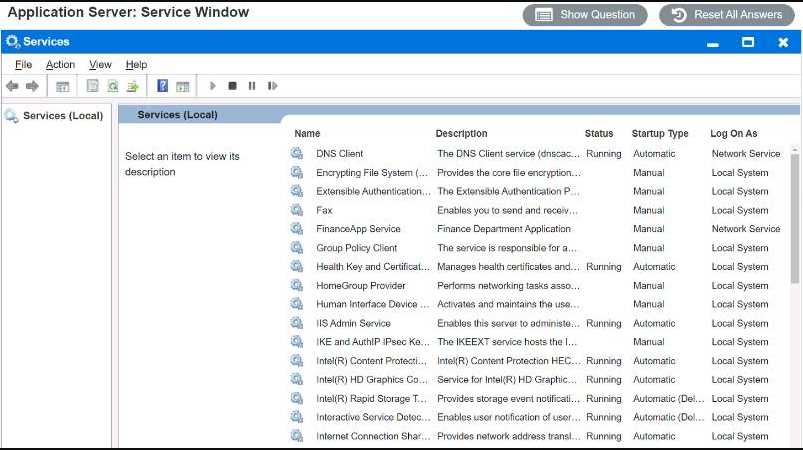
SIMULATION Users report that the FinanceApp software is not running, and they need immediate access. Issues with the FinanceApp software occur every week after the IT team completes server system updates. The users, however, do not want to contact the help desk every time the issue occurs. The users also report the new MarketApp software is not usable when it crashes, which can cause significant downtime. The technician who restarted the MarketApp software noticed it is running under a test account, which is a likely cause of the crashes. INSTRUCTIONS Using the Services menu provided, modify the appropriate application services to remedy the stated issues. CompTIA SK0-005 question
Your Answer
10 comments in the community discussion
4
Yeah, it's all about reliability here. Set FinanceApp Service to Automatic and start it so updates don’t break access each week. For MarketApp, swap that test account for Local System to dodge those random crashes. Pretty sure that’s what they’re looking for, unless extra permissions are needed.
2
Should the FinanceApp service be set to Automatic and started after updates, and for MarketApp switch the log on account from TestAccount to Local System? Really clear scenario, similar to the ones in recent practice sets.
Q: 14

An administrator is troubleshooting performance issues on a server that was recently upgraded. The administrator met with users/stakeholders and documented recent changes in an effort to determine whether the server is better or worse since the changes. Which of the following would BEST help

answer the server performance?


Options
5 comments in the community discussion
8
Makes sense to compare against a baseline. "A server baseline" is the best way to measure if things improved or got worse after changes. You need data from before and after for real analysis. Pretty sure that's the key here, agree?
Doesn't a baseline make it easier to compare before and after with real numbers? I'm not 100 percent, but I always figured you need that old baseline data to see if the upgrade actually helped or made things worse.
Q: 15

HOTSPOT

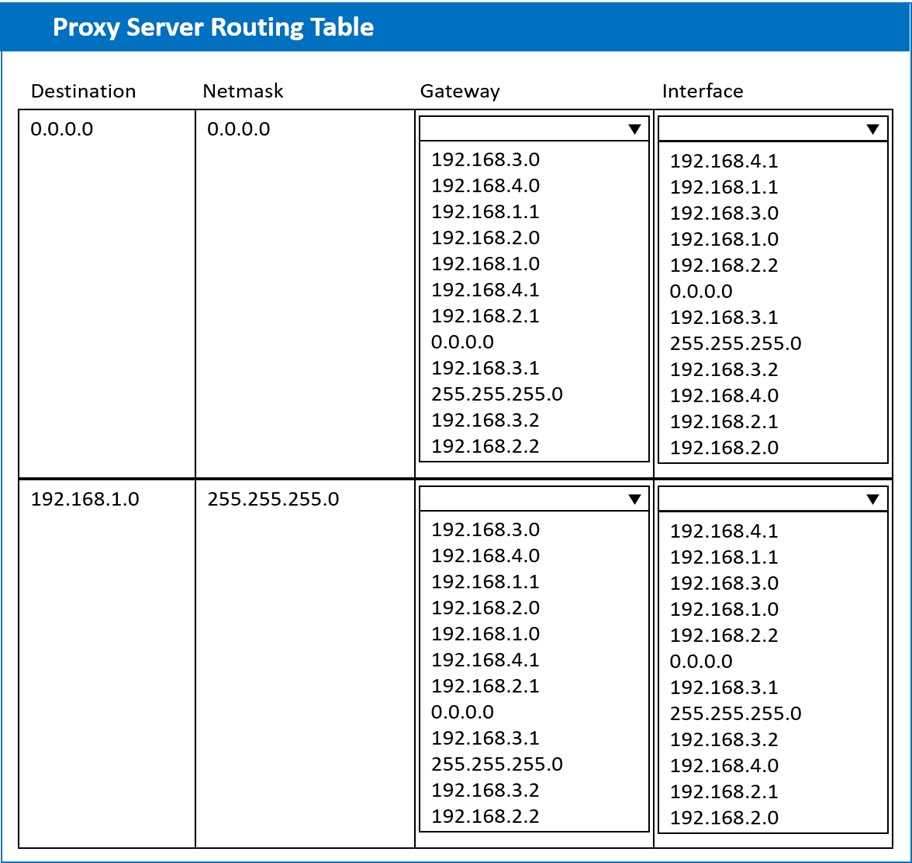
A systems administrator deployed a new web proxy server onto the network. The proxy server has two interfaces: the first is connected to an internal corporate firewall, and the second is connected to an internet-facing firewall. Many users at the company are reporting they are unable to access the Internet since the new proxy was introduced. Analyze the network diagram and the proxy server’s host routing table to resolve the Internet connectivity issues.

INSTRUCTIONS Perform the following steps:

1. Click on the proxy server to display its routing table.

2. Modify the appropriate route entries to resolve the Internet connectivity issue.

If at any time you would like to bring back the initial state of the simulation, please click the Reset All button.

Your Answer
6 comments in the community discussion
2
Looks like both C and A need to be updated to fix the routing. Changing just one route won’t fully solve the issue if users go both ways. Pretty sure that’s what CompTIA wants here, but let me know if you think otherwise.
Default gateway assignment or routing table order? If the question wants the first fix or best long-term fix, it might change which route to modify on the proxy. I saw a similar scenario in official labs and usually, "best" means changing the default gateway towards the internet-facing firewall, but if they're just
Q: 16

DRAG DROP

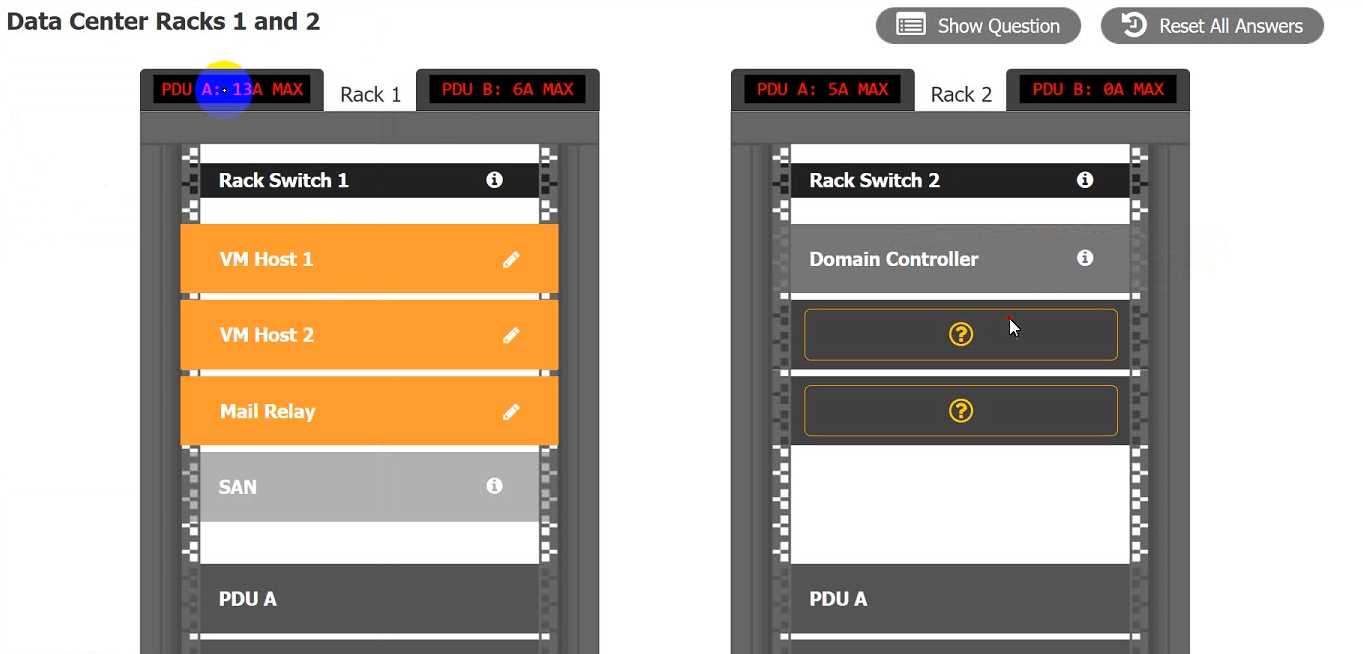
A recent power Outage caused email services to go down. A sever administrator also received alerts from the datacenter’s UPS. After some investigation, the server administrator learned that each POU was rated at a maximum Of 12A.

INSTRUCTIONS

Ensure power redundancy is implemented throughout each rack and UPS alarms are resolved. Ensure the maximum potential PDU consumption does not exceed 80% or 9.6A).

a. PDU selections must be changed using the pencil icon.

b. VM Hosts 1 and 2 and Mail Relay can be moved between racks.

c. Certain devices contain additional details

Drag & Drop
12 comments in the community discussion
6
VM Host 1 → Target 1, Mail Relay → Target 2. This setup keeps the power draw for each rack within that 80% (9.6A) threshold and splits the critical services for redundancy. I think this is what they want to get rid of those UPS alarms, but open to other takes if someone did it differently.
6
Looks like VM Host 1 should go to Target 1 and Mail Relay to Target 2, based on load balancing and not exceeding the PDU threshold. This fits with keeping both power redundancy and max draw under control. Pretty sure this is how you avoid those UPS alarms.
Q: 17
An application server cannot communicate with a newly installed database server. The database server, which has static IP information, is reading the following output from ipconf ig: The application server is reading the following output from ipconf ig: Which of the following most likely contains an error?
Options
15 comments in the community discussion
1
D, not A. Subnet mask mismatch kills local comms fast, IP is a common trap here. Seen similar on practice.
1
C/D? If both are misconfigured, subnet mask usually blocks local traffic, but an invalid gateway could too depending on topology.
Q: 18
Users cannot access a new server by name, but the server does respond to a ping request using its IP address. All the user workstations receive their IP information from a DHCP server. Which of the following would be the best step to perform NEXT?
Options
4 comments in the community discussion
Probably B. If you can ping by IP but not by name, DNS record might be missing.
B tbh. If the server answers to its IP but not its name, it's probably a DNS issue so I'd check if the DNS record is there first.
Q: 19
A server administrator is installing a new server that uses 40G0 network connectivity. The administrator needs to find the proper cables to connect the server to the switch. Which of the following connectors should the administrator use?
Options
10 comments in the community discussion
1
Its A
1
Gotta be D. Only QSFP+ out of these options actually supports 40Gb networking, the rest top out way lower (like SFP+ at 10Gb). I'd double-check the official CompTIA Server+ objectives or hardware guides if unsure, but pretty sure that's what you'll see in their practice tests and labs. Feel free to correct me if I m
Q: 20
Which of the following steps in the troubleshooting theory should be performed after a solution has been implemented? (Choose two.)
Options
5 comments in the community discussion
1
Nah, I'd say C and A. Root cause analysis usually happens after fixing the issue, so it's easy to get tripped up between A and F.
C/F for sure, saw a similar question on a practice exam. Both documenting and telling users come after you fix the issue.
Question 1 of 20

Premium Access Includes

  • Quiz Simulator
  • Exam Mode
  • Progress Tracking
  • Question Saving
  • Flash Cards
  • Drag & Drops
  • 3 Months Access
  • PDF Downloads
Get Premium Access
Scroll to Top

FLASH OFFER

Days
Hours
Minutes
Seconds

avail 10% DISCOUNT on YOUR PURCHASE