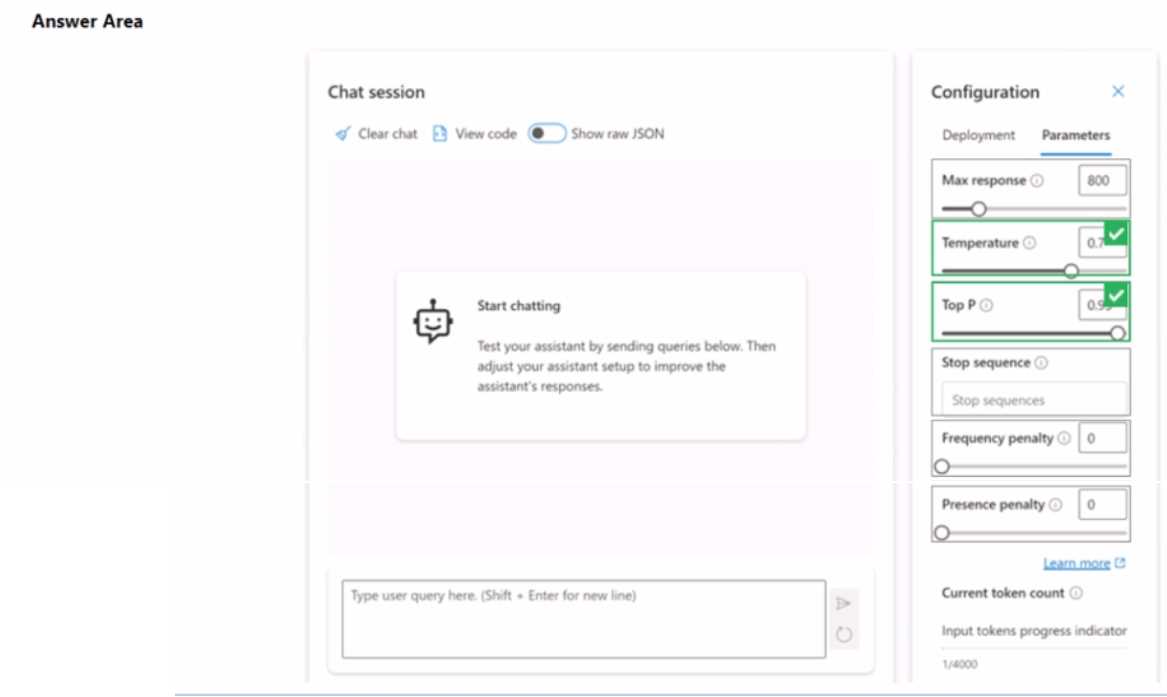
HOTSPOT You build a chatbot by using Azure OpenAI Studio. You need to ensure that the responses are more deterministic and less creative. Which two parameters should you configure? To answer, select the appropriate parameters in the answer area. NOTE: Each correct answer is worth one point. 
Free AI-102 Practice Test Questions and Answers (2026)
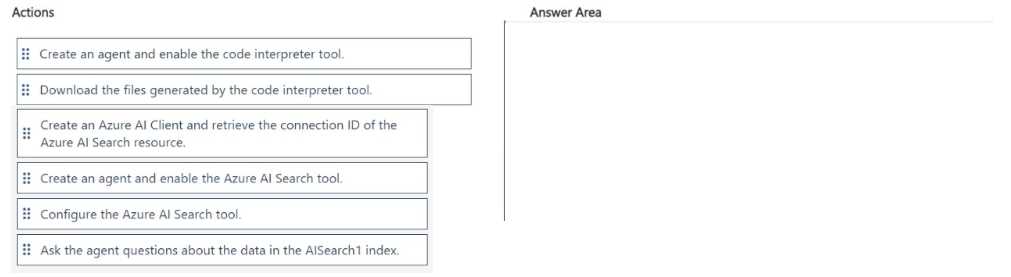
DRAG DROP You have an Azure subscription that contains an Azure Al Search instance named AlSearch1. AlSearch1 contains an index that includes a vector. You need to perform the following actions: • Deploy a new agent by using the Azure Al Agent Service. • Connect the AlSearch1 index to the new agent. • Validate the integration of the index and the agent. Which four actions should you perform in sequence? To answer, move the appropriate actions from the list of actions to the answer area and arrange them in the correct order.
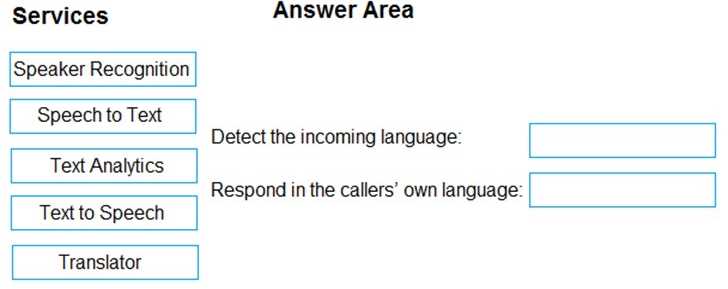
DRAG DROP You need to develop an automated call handling system that can respond to callers in their own language. The system will support only French and English. Which Azure Cognitive Services service should you use to meet each requirement? To answer, drag the appropriate services to the correct requirements. Each service may be used once, more than once, or not at all. You may need to drag the split bat between panes or scroll to view content. NOTE: Each correct selection is worth one point.
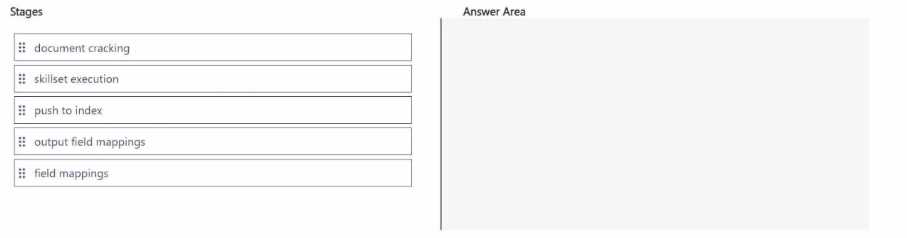
DRAG DROP You have an Azure subscription that contains an Azure Al Search resource named AS1. You implement a custom skill in AS1 that performs language and sentiment analysis of documents. You ate evaluating the use of AS1 as part of an enrichment pipeline. In which order will AS1 index the documents? To answer, move all indexing stages from the list of stages to the answer area and arrange them in the correct order.
HOTSPOT You are building an app that will process incoming email and direct email messages to either French or English language support teams. Which Azure Cognitive Services API should you use? To answer, select the appropriate options in the answer area. NOTE: Each correct selection is worth one point.
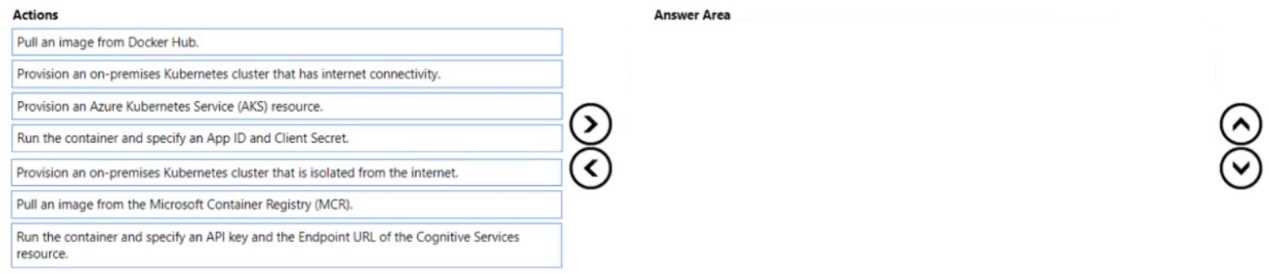
DRAG DROP You are building an app that will scan confidential documents and use the Language service to analyze the contents. You provision an Azure Cognitive Services resource. You need to ensure that the app can make requests to the Language service endpoint. The solution must ensure that confidential documents remain on-premises. Which three actions should you perform in sequence? To answer, move the appropriate actions from the list of actions to the answer area and arrange them in the correct order.
HOTSPOT For each of the following statements, select Yes if the statement is tine. Otherwise, select No. NOTE: Each correct selection is worth one point.
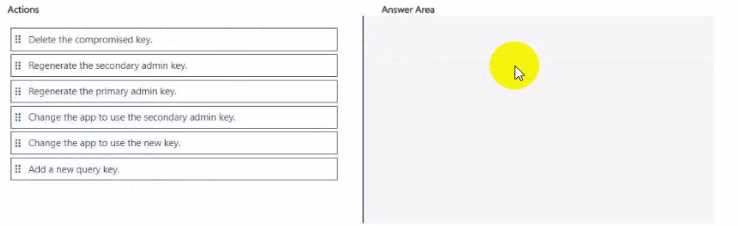
DRAG DROP You have a web app that uses Azure AI search. When reviewing activity, you see greater than expected search query volumes. You suspect that the query key is compromised. You need to prevent unauthorized access to the search endpoint and ensure that users only have read only access to the documents collection. The solution must minimize app downtime. Which three action should you perform in sequence? To answer, more the appropriate actions from the list of actions to the answer area and arrange them in the correct order.
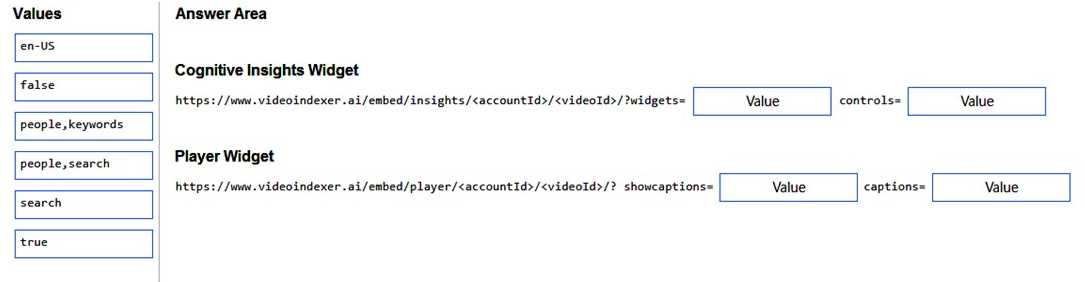
DRAG DROP You are developing a webpage that will use the Video Indexer service to display videos of internal company meetings. You embed the Player widget and the Cognitive Insights widget into the page. You need to configure the widgets to meet the following requirements: Ensure that users can search for keywords. Display the names and faces of people in the video. Show captions in the video in English (United States). How should you complete the URL for each widget? To answer, drag the appropriate values to the correct targets. Each value may be used once, more than once, or not at all. You may need to drag the split bar between panes or scroll to view content. NOTE: Each correct selection is worth one point.
DRAG DROP You have an app that manages feedback. You need to ensure that the app can detect negative comments by using the Sentiment Analysis API in Azure Cognitive Service for Language. The solution must ensure that the managed feedback remains on your company's internal network. Which three actions should you perform in sequence? To answer, move the appropriate actions from the list of actions to the answer area and arrange them in the correct order. NOTE: More than one order of answer choices is correct You will receive credit for any of the correct orders you select.
HOTSPOT You plan to deploy an Azure OpenAI resource by using an Azure Resource Manager (ARM) template. You need to ensure that the resource can respond to 600 requests per minute. How should you complete the template? To answer, select the appropriate options in the answer area. NOTE: Each correct selection is worth one point.
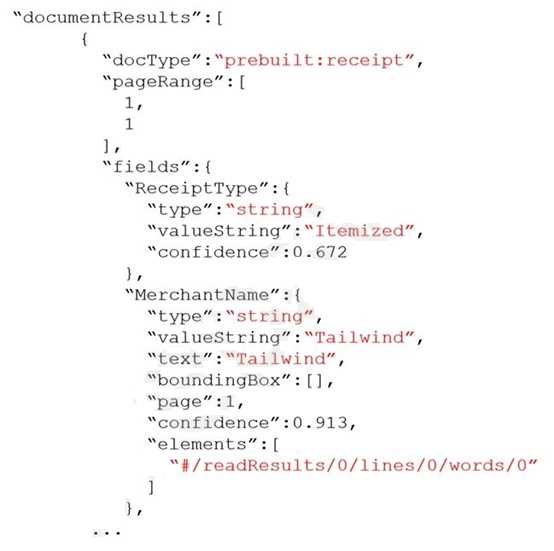
Which expression should you use to trigger a manual review of the extracted information by a
member of the Consultant-Bookkeeper group?DRAG DROP You train an Azure Custom Vision object detection model to identify a company's products by using the Retail domain. You plan to deploy the model as part of a mobile app for Android phones. You need to prepare the model for deployment. Which three actions should you perform in sequence? To answer, move the appropriate actions from the list of actions to the answer area and arrange them in the correct order.

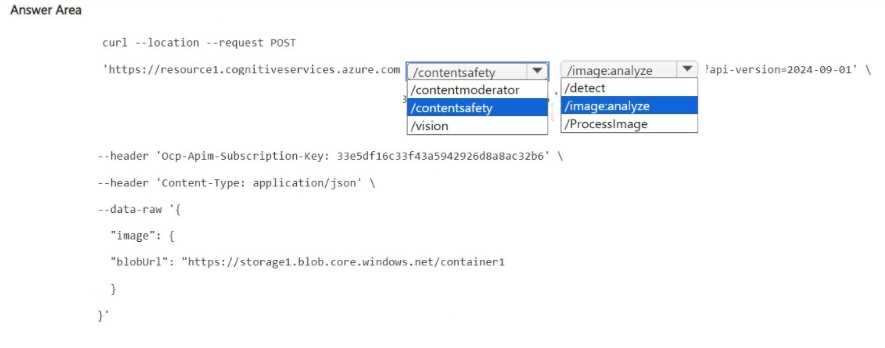
HOTSPOT You have an Azure subscription that contains an Azure Al Content Safety resource named Resource1 and a storage account named storage1. You create a blob container named container1 and upload a sample set of image files to container1. You need to validate whether Resource1 can identify images that contain potential violence. How should you complete the cURL command? To answer, select the appropriate options in the answer area. NOTE: Each correct selection is worth one point.
What's covered in this practice questions set
4: Implement natural language processing solutions · 9 questions
📖 About this Domain
This domain covers implementing solutions that process text and speech using Azure AI services. You will use Azure AI Language to extract insights from text and Azure AI Speech to integrate voice capabilities. Core tasks involve provisioning resources, performing text analysis, building conversational language understanding models, and implementing speech synthesis and recognition.
🎓 What You Will Learn
- You will learn to use the Azure AI Language service for key phrase extraction, named entity recognition (NER), and sentiment analysis.
- You will learn to build, train, and deploy custom text classification and custom named entity recognition models for specific domains.
- You will learn to create a conversational language understanding model to map user utterances to intents and extract entities.
- You will learn to integrate the Azure AI Speech service for speech-to-text transcription and text-to-speech synthesis using the SDK.
🛠️ Skills You Will Build
- You will build the skill to provision Azure AI Language resources and use the client library to perform text analytics.
- You will build proficiency in designing a conversational language understanding schema, including defining intents, entities, and training utterances.
- You will build the ability to train, evaluate, and deploy custom NLP models for tasks like custom text classification.
- You will build the capability to implement real-time speech recognition and synthesis in an application using the Azure AI Speech SDK.
💡 Top Tips to Prepare
- Gain hands-on experience with the Python or C# SDKs for both Azure AI Language and Azure AI Speech services.
- Master the core components of conversational language understanding, specifically the distinction between intents, entities, and utterances.
- Understand the process for provisioning Azure AI services resources, managing keys, and identifying the correct endpoint URI.
- Know when to use a pre-built model versus when to build a custom model for tasks like text classification or NER.
1: Plan and manage an Azure AI solution · 5 questions
📖 About this Domain
This domain covers the foundational process of selecting the correct Azure AI services based on business requirements. It emphasizes planning for security, monitoring, and the implementation of Responsible AI principles within a solution.
🎓 What You Will Learn
- You will learn to select the appropriate Azure AI service, including Azure Cognitive Services, Azure Applied AI Services, and Azure Machine Learning.
- You will learn to plan and configure security for an Azure AI solution by managing authentication, access control with RBAC, and secrets with Azure Key Vault.
- You will learn to create and manage Azure AI services, including resource provisioning, endpoint management, and configuring diagnostic logging.
- You will learn to plan and implement a Responsible AI solution by applying Microsoft's principles and using tools like the Responsible AI dashboard and Azure AI Content Safety.
🛠️ Skills You Will Build
- You will build the skill to architect AI solutions by mapping business requirements to specific Azure AI services and components.
- You will build skills in securing AI workloads by implementing authentication, role-based access control (RBAC), and managed identities.
- You will build the skill to provision and manage the lifecycle of Azure AI resources using the Azure portal, CLI, and ARM templates.
- You will build the skill to integrate Responsible AI practices, including fairness, transparency, and content safety, into your solution design.
💡 Top Tips to Prepare
- Focus on the specific use cases for each service in the Azure AI portfolio to master service selection questions.
- Gain hands-on experience with Azure Active Directory, creating service principals, assigning RBAC roles, and managing keys in Azure Key Vault.
- Practice provisioning Azure AI resources, paying close attention to available pricing tiers, network configurations like private endpoints, and monitoring options.
- Memorize the six Microsoft Responsible AI principles and understand how tools like Azure Machine Learning's Responsible AI dashboard address them.
3: Implement Azure AI Vision solutions · 4 questions
📖 About this Domain
This domain covers the implementation of computer vision solutions using Azure AI Vision services. You will analyze images and videos to extract information, identify objects, and read text. The focus is on integrating pre-built models and creating custom vision solutions.
🎓 What You Will Learn
- You will learn to use the Image Analysis service to extract a wide range of visual features from images.
- You will learn to implement the Read API for Optical Character Recognition (OCR) to extract text from images and documents.
- You will learn to build, train, and deploy custom image classification and object detection models using the Custom Vision service.
- You will learn to use the Face service to detect, analyze, and identify human faces in images.
🛠️ Skills You Will Build
- You will build skills to provision and manage Azure AI Vision resources through the Azure portal and CLI.
- You will build skills to integrate the Azure AI Vision SDK into applications to perform image analysis and OCR.
- You will build skills to train, evaluate, and publish custom models using the Custom Vision portal and SDK.
- You will build skills to process video streams for near-real-time analysis using Azure Video Indexer.
💡 Top Tips to Prepare
- Gain hands-on experience with the Azure AI Vision SDKs in both Python and C# to understand API request and response structures.
- Clearly distinguish between the use cases for the Image Analysis service versus a custom-trained Custom Vision model.
- Master the asynchronous operation pattern of the Read API, including how to submit a job and retrieve the results.
- Practice the end-to-end workflow for Custom Vision projects, from image tagging and training to model evaluation and endpoint consumption.
5: Implement knowledge mining and document intelligence solutions · 1 questions
📖 About this Domain
This domain covers implementing knowledge mining solutions using Azure AI Search to index and query unstructured data. You will also learn to implement Azure AI Document Intelligence to extract data from forms and documents, automating data entry.
🎓 What You Will Learn
- You will learn to provision an Azure AI Search service, create a data source, and define a search index.
- You will learn to create and attach a cognitive skillset to an indexer to enrich data during ingestion.
- You will learn to use Azure AI Document Intelligence prebuilt and custom models to extract key-value pairs and tables.
- You will learn to create a client application that queries a search index to find information.
🛠️ Skills You Will Build
- You will build the skill to configure an Azure AI Search indexer, including field mappings and scheduling.
- You will build the skill to implement a custom skillset to extend the data enrichment pipeline.
- You will build the skill to train a custom Azure AI Document Intelligence model using labeled data in Document Intelligence Studio.
- You will build the skill to write complex search queries using Lucene syntax and filtering expressions.
💡 Top Tips to Prepare
- Focus on the components of the Azure AI Search indexing pipeline: data source, skillset, index, and indexer.
- Practice creating and testing cognitive skillsets, as they are central to knowledge mining.
- Understand the differences between prebuilt, custom template, and custom neural models in Azure AI Document Intelligence.
- Complete the hands-on labs in the official Microsoft Learn modules for AI-102 to gain practical experience with both services.
2: Implement decision support solutions · 1 questions
📖 About this Domain
This domain covers implementing AI solutions that extract insights from unstructured data to aid organizational decision-making. It focuses on Azure AI services for knowledge mining, content moderation, and intelligent document processing. You will build systems that analyze text, images, and documents to provide actionable intelligence.
🎓 What You Will Learn
- You will learn to implement Azure AI Content Safety to detect and filter inappropriate user-generated content in text and images.
- You will learn to create a knowledge mining solution using Azure AI Search by building an index, ingesting data, and applying a cognitive skillset.
- You will learn to use Azure AI Document Intelligence to extract text, key-value pairs, and tables from documents with prebuilt and custom models.
- You will learn to integrate various decision support services to create a comprehensive AI solution.
🛠️ Skills You Will Build
- You will build the skill to configure and manage an Azure AI Search service, including defining indexers, data sources, and skillsets.
- You will build the ability to train, deploy, and use custom models in Azure AI Document Intelligence for specialized document extraction.
- You will build proficiency in using the Azure AI Content Safety service to moderate content based on specific harm categories and severity levels.
- You will build the technical skill to consume these services programmatically using their respective REST APIs and SDKs.
💡 Top Tips to Prepare
- Gain hands-on experience with the Azure AI Document Intelligence Studio to label and train both custom template and custom neural models.
- Focus on the components of an Azure AI Search skillset, understanding how to chain built-in skills to enrich an index during ingestion.
- Understand the specific harm categories and severity levels within Azure AI Content Safety for both text and image analysis.
- Practice creating and querying Azure AI Search indexes using both the Azure portal and the REST API to understand the full workflow.